A prototype that looks convincing on a desk can still fail when it is dropped, heated, loaded, or manufactured at scale. That is why the decision between 3D printing versus CNC machining is not simply about price or speed. It is a product-development decision that affects how you test your idea, refine its design, document its performance, and prepare it for production.
For inventors and founders, the right answer is often not one method forever. It may be 3D printing for early fit checks, CNC machining for functional validation, and a different manufacturing process once the product is ready to launch. The key is choosing the process that gives you the information you need at the current stage, without wasting budget on a prototype that cannot answer the right questions.
3D Printing Versus CNC Machining: The Core Difference
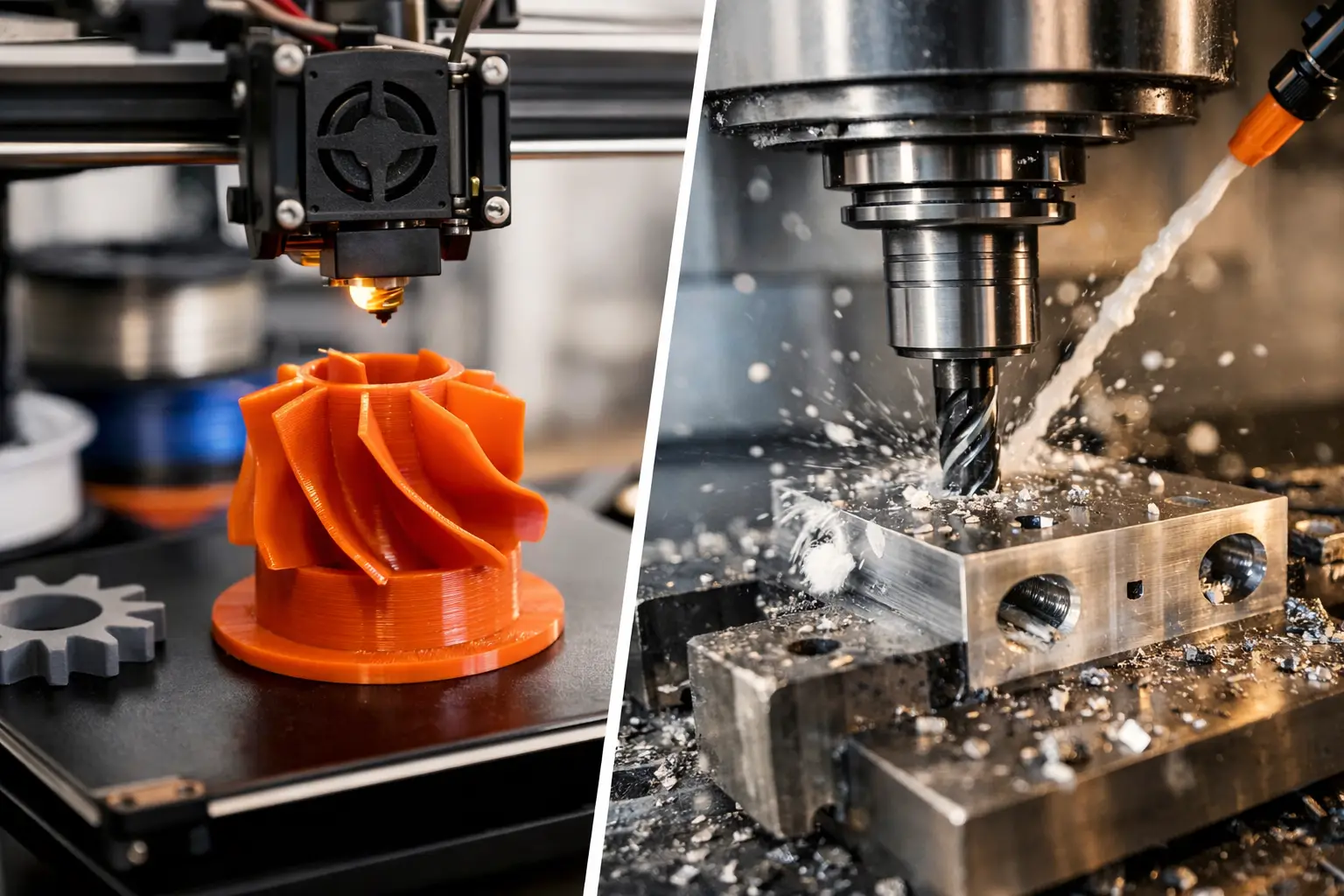
3D printing is an additive process. A machine builds a part layer by layer from a digital model, using materials such as plastic filament, resin, nylon powder, or metal powder. Because material is added only where the design calls for it, 3D printing can produce complex forms with minimal setup.
CNC machining is a subtractive process. A computer-controlled mill, lathe, router, or similar machine removes material from a solid block or bar stock. The result is a part cut from the same class of material often used in finished products, including aluminum, steel, brass, acetal, polycarbonate, and many engineering plastics.
That distinction changes nearly every practical consideration. Additive manufacturing is usually more flexible for changing geometry. CNC machining generally provides tighter tolerances, stronger parts, better surface finishes, and more predictable material behavior. Neither process is automatically better. The question is what your prototype must prove.
When 3D Printing Is the Smart Choice
For an early-stage product, 3D printing is often the fastest way to turn an idea into something you can hold. A founder can move from a CAD model to a physical form in days, sometimes sooner, without paying for custom tooling. This is especially valuable when the design is still changing.
Use 3D printing when you need to evaluate the overall size, shape, ergonomics, assembly sequence, or visual appeal of a product. A handheld consumer device, enclosure, kitchen tool, medical accessory, or wearable product may require several rounds of adjustment before the basic form is right. Printing those revisions is usually far more economical than machining every version.
The process also enables geometry that would be difficult or costly to machine. Internal channels, lattice structures, organic surfaces, and nested features can be printed with fewer manufacturing constraints. For certain products, those capabilities create real design advantages rather than just visual novelty.
Still, a printed part has limits. Layer lines may affect appearance and strength. The part can be weaker in one direction than another, depending on its build orientation. Resin prints can be detailed but brittle. Filament prints are accessible and affordable but may not accurately represent the material properties of a molded production part.
A 3D-printed housing may be excellent for checking button placement and internal component clearance, yet unsuitable for proving that a latch will survive thousands of cycles. It is a tool for learning quickly, not a shortcut around engineering validation.
Where 3D Printing Saves Time and Money
The strongest case for 3D printing is iteration. If your design has open questions, inexpensive revisions can prevent expensive mistakes later. You can compare several handle angles, wall thicknesses, lid concepts, or internal layouts before committing to a more demanding prototype process.
It is also useful for patent-oriented proof-of-concept models. A physical prototype can help communicate how an invention works, identify overlooked features, and support clearer discussions with engineers, manufacturers, and patent counsel. The model does not need to be production-perfect to be valuable. It needs to demonstrate the inventive concept credibly.
When CNC Machining Is the Better Investment
CNC machining becomes more attractive when function matters as much as form. If your prototype must carry a load, withstand impact, hold close tolerances, resist heat, or fit precisely with other components, machined parts can deliver a more meaningful result.
Because CNC parts are made from solid material, they usually behave more like final production parts. A machined aluminum bracket can be tested for rigidity. A machined acetal gear can be assessed for fit and movement. A polycarbonate component can provide a more realistic indication of toughness than a visually similar printed substitute.
Machining also provides excellent dimensional control. Products involving seals, bearings, threaded features, shafts, precision mating surfaces, or electro-mechanical assemblies often need tolerances that consumer-grade printing cannot consistently achieve. Even high-end industrial printers have tolerances and finishing considerations that must be evaluated carefully.
Surface finish is another practical factor. Machined components can be polished, bead blasted, anodized, painted, or otherwise finished to meet functional and presentation needs. This matters when a prototype will be shown to investors, potential customers, buyers, or licensing partners. It matters even more when the prototype must operate reliably during demonstrations.
What CNC Machining Cannot Do as Easily
CNC machining requires more setup and programming, particularly for complicated parts. Material is removed rather than added, which can create more waste. Deep internal passages, enclosed voids, and highly organic shapes may require multiple operations or may be impractical to machine at all.
The cost per part can also be higher during frequent design changes. If you are still deciding whether a product should be two inches wider or whether a hinge needs to move a quarter inch, machining every revision may burn budget before the design has earned that level of precision.
This is why machining is best used deliberately. Do not choose it just because the part feels more professional. Choose it when the material, tolerance, durability, or finish will directly influence a decision you need to make.
Compare the Methods by Product Stage
The most efficient development path often combines both technologies. Early concept work favors speed and flexibility. Functional engineering favors material performance and precision. Pre-production preparation favors processes that reflect how the product will eventually be made.
At the concept stage, 3D printing can help determine whether the product is comfortable, understandable, and physically feasible. It lets you expose design problems before they become embedded in a costly engineering package.
At the functional prototype stage, CNC machining may be necessary for high-stress components, mechanical interfaces, and parts that interact with motors, electronics, fasteners, seals, or moving assemblies. A hybrid prototype is common: printed enclosure pieces paired with machined brackets, gears, shafts, or heat-sensitive components.
At the manufacturing stage, the comparison changes again. Neither 3D printing nor CNC machining is always the best production process for large quantities. Injection molding, casting, stamping, extrusion, or other methods may reduce per-unit cost once demand is established. But the prototype work completed before that decision determines whether production tooling is built around a design that actually works.
Questions to Ask Before You Choose
Before approving a prototype, define what success looks like. Is the purpose to show an invention to a potential partner? Test a mechanical mechanism? Verify the fit of circuit boards and batteries? Produce a customer-ready demonstration model? Support a patent filing strategy? The answer should guide the process.
Also consider the final material and manufacturing method. If the product will ultimately be injection-molded ABS, a printed PLA model may be useful for form but misleading for durability. If the product depends on aluminum’s rigidity or thermal behavior, machining aluminum is likely worth the added investment.
Tolerance requirements deserve the same attention. A loose-fit cover may tolerate a printed prototype. A pump, valve, gear train, or locking mechanism may not. Small inaccuracies can create large functional failures when several parts must work together.
Finally, be honest about the cost of being wrong. A lower-cost printed prototype is a smart choice when it will answer the current question. A higher-cost machined prototype is a smart choice when failure in testing, a customer demonstration, or a manufacturing handoff would create a much larger setback.
Build the Prototype That Moves the Idea Forward
The right prototype is not necessarily the prettiest one or the least expensive one. It is the one that reduces uncertainty and gives you a clear next move. For many new products, that means planning a sequence of prototypes rather than expecting one part to do every job.
Industry of Concepts helps inventors and businesses turn early concepts into purposeful prototypes, with the engineering discipline needed to test what matters and prepare for commercialization. Bring your idea forward by defining the question your next prototype must answer, then choose the process that can answer it with confidence.