A hand sketch can communicate the promise of an invention. It cannot tell you whether the housing has room for a battery, whether two parts will interfere with each other, or whether a customer can comfortably use the product. That is where computer modeling for product development becomes a practical business decision, not just a design step.
For inventors and product founders, a well-built digital model turns an idea into something that can be inspected, tested, revised, quoted, prototyped, and eventually manufactured. It creates a clearer path forward before you commit money to tooling, materials, and multiple rounds of physical prototypes.
What Computer Modeling Does for a New Product
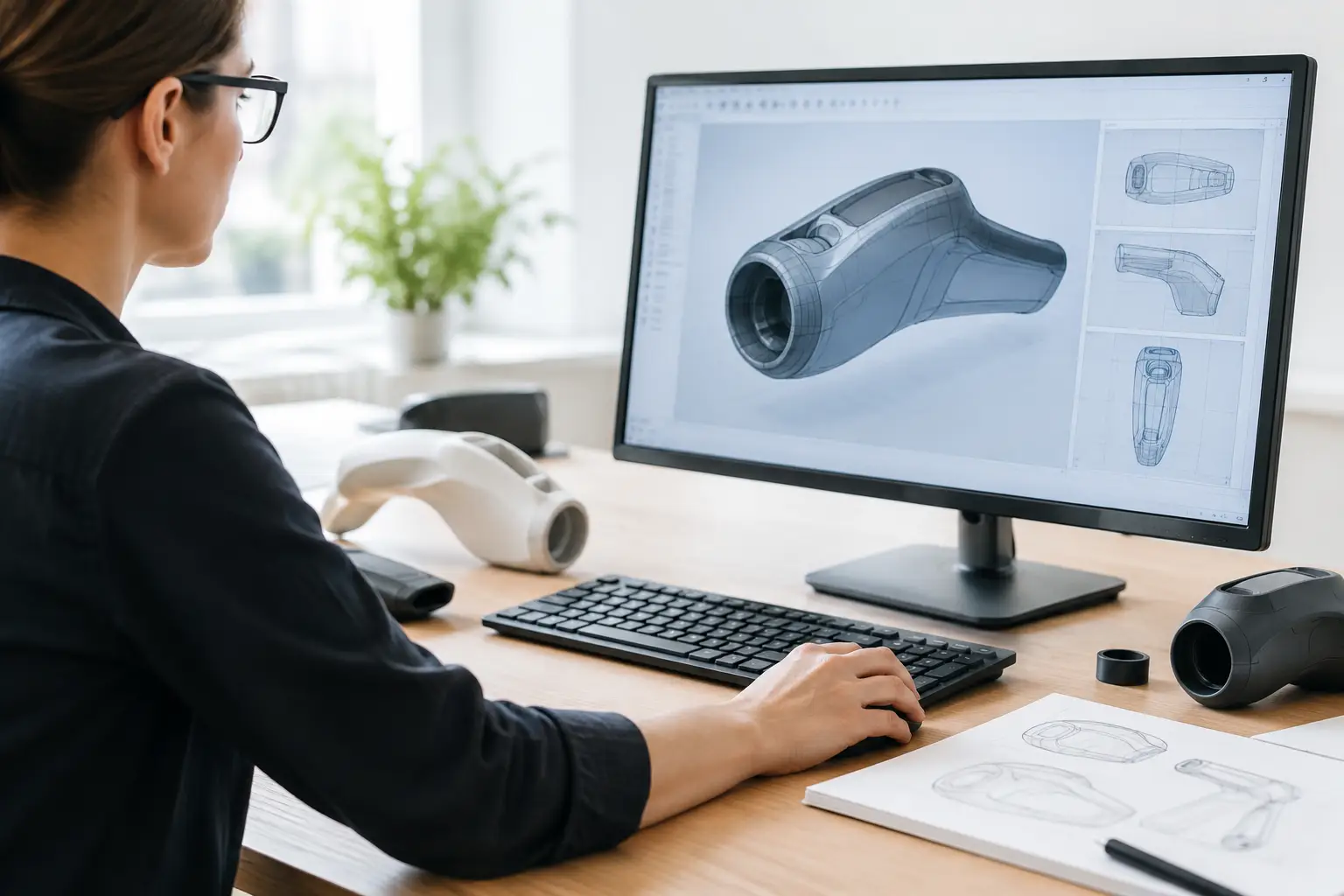
Computer modeling uses specialized CAD software to create a precise digital representation of a product and its components. Depending on the project, that model may show the product’s exterior form, internal features, moving parts, electronics space, assembly methods, material thicknesses, and manufacturing details.
The value is not simply that the product looks realistic on a screen. A professional model gives dimensions, relationships, and constraints to an idea that may have started as a sketch, a sample product, or a verbal description. It forces the right questions early: How will this part attach? Can it be molded? Is there enough clearance for a switch, spring, motor, or circuit board? Can a user grip it safely and comfortably?
This is especially valuable when an invention combines several disciplines. A consumer device may need an attractive enclosure, a workable mechanism, room for electronics, fasteners that can be assembled reliably, and surfaces that support a brand identity. Those requirements must work together. A model helps the design team identify conflicts before they become expensive physical problems.
Computer Modeling for Product Development Reduces Guesswork
Physical prototypes are essential, but they should not be the first place a product’s basic geometry is figured out. Building a prototype before the design has been properly modeled often creates a cycle of avoidable changes: parts do not fit, wall thickness is wrong, a mechanism binds, or a feature that looked simple on paper cannot be made economically.
Digital modeling lets a team revise quickly and with purpose. If a product needs a larger battery compartment, the surrounding components can be adjusted in the model. If a handle feels too bulky in a rendering or ergonomic review, its contours can be refined before fabrication. If the manufacturer recommends a different process, the design can be updated to reflect realistic production requirements.
That does not mean computer modeling eliminates every risk. Software cannot fully predict how customers will react to a product or how every material will behave under every real-world condition. It does, however, replace assumptions with measurable information. For an entrepreneur managing a limited budget, that difference matters.
Modeling the Form, Function, and Fit
A successful model addresses more than appearance. Product development usually requires three connected areas of work: form, function, and fit.
Form concerns what the product looks and feels like. This includes proportions, surface geometry, visual balance, grip areas, branding locations, and the overall user experience. For consumer-facing products, form affects whether the product appears credible, intuitive, and worth buying.
Function concerns what the product must do. A model can define moving mechanisms, latches, hinges, gears, buttons, airflow paths, liquid channels, or electrical component locations. It gives engineers a working framework for evaluating whether the product concept can perform as intended.
Fit concerns how components come together. Small errors in fit can create major issues in a prototype or production run. Digital assemblies allow designers to check clearances, part alignment, fastening locations, and the sequence required to put the product together. This is often where hidden design problems become visible.
From Idea to a Prototype You Can Test
The modeling process should begin with the business and technical goals of the product, not with software alone. An experienced development partner first needs to understand the product’s intended user, key function, likely price range, competitive category, and path to manufacturing.
For example, a one-off proof-of-concept prototype may need a different level of detail than a design heading toward injection molding. A simple visual model can help communicate an idea to investors, while a functional prototype model needs accurate mechanical features and engineering allowances. A manufacturing-ready model may require draft angles, tolerances, ribs, bosses, parting lines, and specifications that are unnecessary at the concept stage.
The right level of modeling depends on what decision you need to make next. Overbuilding a model too early can waste time and money. Underbuilding it can create confusion and leave costly questions unanswered. The goal is progress that supports the next milestone.
At Industry of Concepts, computer modeling can serve as the bridge between early concept development and rapid prototyping. It helps turn a promising idea into a defined product architecture that can be reviewed, refined, and built for real-world evaluation.
What You Should Bring to the First Modeling Discussion
You do not need a complete engineering package to start. Many successful projects begin with a rough sketch, a written explanation, a photo of a similar product, or a basic mockup made from household materials. What matters is being clear about the problem your product solves and the experience you want the user to have.
It also helps to identify any non-negotiables. Perhaps the product must fit in a cup holder, use an existing battery type, support a certain load, meet a target retail price, or avoid copying known competitor features. These constraints guide design choices from the beginning.
Be prepared to discuss what happens inside the product as well as outside. If your invention includes electronics, moving parts, fluids, heat, or user-applied force, those factors should shape the model from the first stages. A beautiful exterior cannot compensate for an internal layout that cannot be assembled or serviced.
Modeling Supports Better Patent and Manufacturing Decisions
For many inventors, intellectual property protection is part of the reason to develop a prototype in the first place. A detailed model can help communicate the structure and operation of an invention more clearly during patent-oriented development. It can illustrate how components interact and identify the features that may distinguish the product from what already exists.
A digital model is not a substitute for legal advice or a patentability determination. Still, it can provide useful technical material for working with qualified patent professionals. Clear drawings, defined mechanisms, and a proof-of-concept prototype make it easier to explain what the invention is and how it works.
The same model also supports manufacturing conversations. Suppliers need more than an attractive image to provide meaningful feedback. They need to understand dimensions, materials, assembly requirements, and production expectations. Early manufacturing input may lead to design changes, but those changes are far easier to make in CAD than after tooling has begun.
There are trade-offs. A design optimized for low-volume 3D printing may not be ideal for injection molding. A complex mechanism may create a stronger market story but increase assembly cost and reliability risk. Computer modeling makes these choices visible, allowing you to decide where complexity adds customer value and where it simply adds cost.
Common Mistakes That Slow Product Development
One common mistake is treating CAD as a cosmetic rendering service. Renderings can be useful for sales presentations, investor discussions, and market feedback, but they are not automatically engineering models. A product must still be designed for function, prototype fabrication, and production.
Another mistake is locking in a feature before testing the user experience. Founders sometimes become attached to an initial shape or mechanism because it was part of the original idea. If modeling reveals a safer, less expensive, or easier-to-use alternative, that is valuable information, not a setback.
It is also risky to wait until the end to consider manufacturing. Material selection, fastening methods, wall thickness, and tolerances affect the design from the start. Bringing these considerations into the model early helps avoid a design that works only as a single handmade prototype.
Move Forward With a Model Built for the Next Decision
Computer modeling gives your product idea a working structure. It lets you see the product before it exists, identify engineering questions before they become prototype failures, and make decisions based on design reality rather than hope.
The strongest next step is not always a fully finished product model. Sometimes it is a focused concept model, an assembly study, or a proof-of-function design that answers one critical question. Start with the uncertainty that could cost you the most, then build the model that helps you resolve it with confidence.