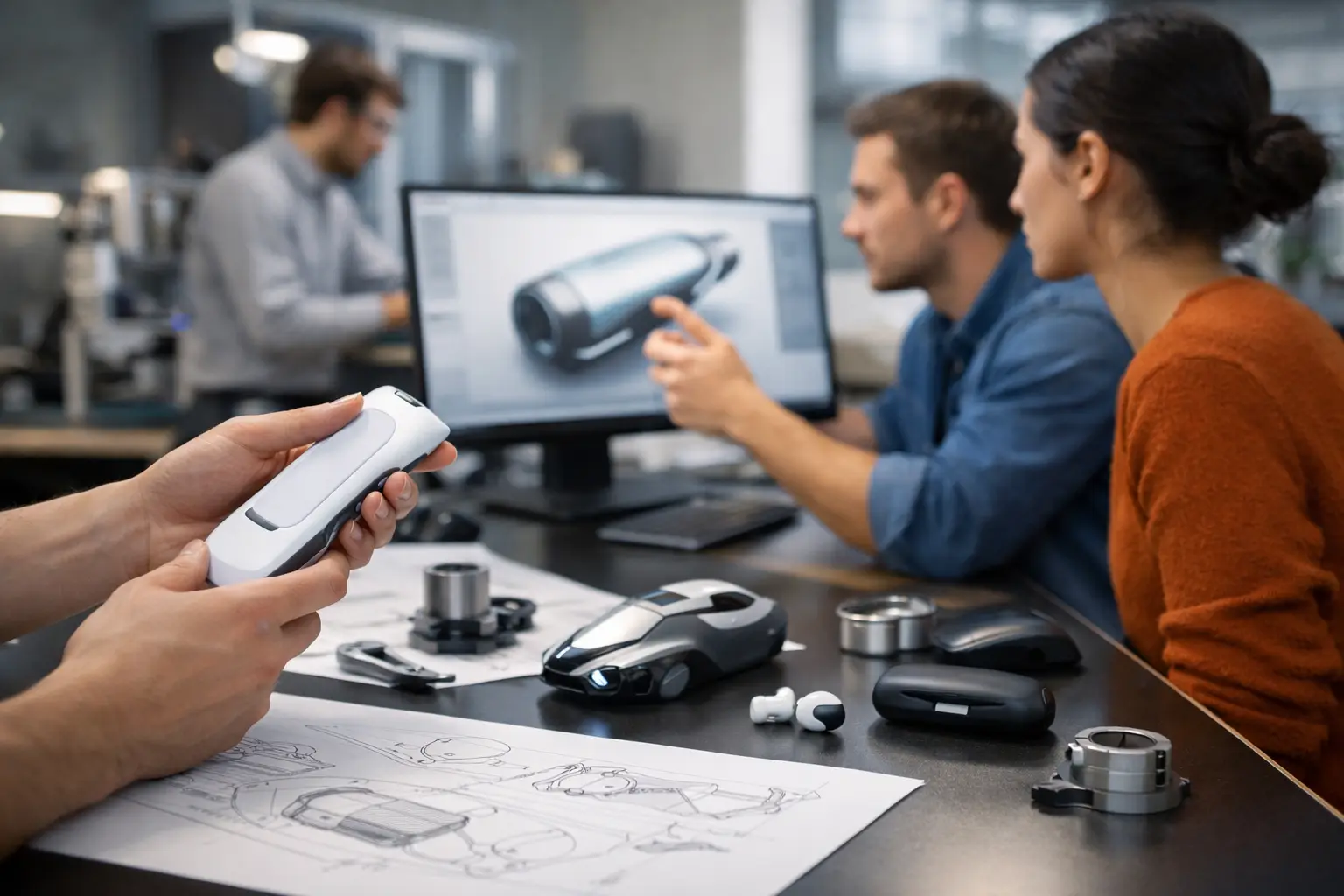
A product idea can sound simple until it has to fit in someone’s hand, survive repeated use, meet a target cost, and be manufactured consistently. That is where industrial design firms earn their value. They turn an early concept, sketch, or rough prototype into a product people can understand, use, and want to buy.
For inventors and growing businesses, the right design partner does more than make an idea look polished. It helps answer the hard questions early: What problem does this product solve? Who will use it? Can it be built reliably? What needs to be proven before money is committed to tooling or production? The answers shape whether a product becomes a real commercial opportunity or an expensive unfinished project.
What Industrial Design Firms Actually Do
Industrial design sits at the meeting point of user needs, physical form, engineering constraints, and business goals. A strong firm examines how a product should look and feel, but it also considers how the product will function, how its components fit together, and how it can move toward manufacturing.
The work often begins with concept development. A designer may translate a client’s explanation, photos, sketches, or existing product into clear visual directions. This is not decoration. Early concepts establish the product’s purpose, features, size, user interaction, and overall identity before significant engineering time is spent.
From there, computer-aided design models give the idea physical definition. A 3D model can reveal issues that are easy to miss in a drawing, such as insufficient space for electronics, poor grip geometry, awkward access to controls, or parts that will be difficult to mold or assemble. Rapid prototypes then make those lessons tangible. Holding and testing a model often changes a project faster than another round of discussion ever could.
The best firms also work closely with mechanical and electrical engineers. A beautiful housing that cannot accommodate a battery, sensor, motor, fastener, or safety requirement is not a finished design. Product development requires both creative thinking and technical discipline.
Why Good Design Affects More Than Appearance
Customers form opinions about a product quickly. They notice whether it feels intuitive, durable, comfortable, and credible. They also notice friction: a cap that is difficult to open, a button that is hard to find, instructions that are not obvious, or a product that seems fragile the first time it is handled.
Good industrial design reduces that friction. It can simplify the number of parts, make the intended use more obvious, and improve the relationship between the user and the product. For a startup, those details can influence reviews, repeat purchases, returns, and word-of-mouth growth.
Design also affects cost. A product with unnecessary complexity may require more components, longer assembly time, specialized materials, or difficult manufacturing processes. On the other hand, designing only for the lowest initial cost can produce a product that feels generic or fails too soon. The right choice depends on the market, expected sales volume, product category, and brand position.
That is why the most useful design conversations include commercial questions alongside aesthetic ones. Is this a premium consumer product or a jobsite tool? Is it being made in small batches first, or is it preparing for high-volume production? Does the product need to support a patent strategy? A qualified team designs with those realities in mind.
When to Bring in an Industrial Design Partner
Many founders wait until they think their idea is fully defined. Usually, that is later than necessary. Professional input is most valuable when key decisions are still flexible and inexpensive to change.
If you have a problem worth solving but no clear product form, an industrial design firm can help turn your idea into viable concepts. If you have a sketch or a homemade model, the firm can assess what it proves and what remains uncertain. If you already have a prototype, design and engineering work can identify usability, durability, and manufacturing issues before the product goes further.
There is a difference between a visual mockup and a proof-of-concept prototype. A visual model may communicate the intended form. A proof-of-concept prototype demonstrates whether the core function can work. For many inventions, especially products involving moving parts, electronics, or new mechanisms, both are necessary. They answer different questions for customers, investors, manufacturers, and patent professionals.
Early support can also help protect project momentum. Inventors often lose time moving between separate freelancers for design, modeling, prototyping, engineering, and manufacturing guidance. A coordinated product development partner can keep decisions connected from one phase to the next.
How to Evaluate Industrial Design Firms
Portfolios matter, but they are not the entire evaluation. A striking portfolio may show visual talent, yet your product needs practical development experience as well. Ask how the firm moves from a design concept to a functional prototype and what engineering resources are available when technical problems appear.
Look for a team that asks detailed questions before promising an outcome. They should want to know who the user is, what makes the product different, what must happen for it to work, where it will be sold, and what stage of development you have reached. A firm that immediately jumps to renderings without understanding the problem may create attractive images without building a usable development path.
You should also ask how the firm handles ownership and confidentiality. Your ideas, drawings, CAD files, prototypes, and development records have value. Clear agreements and a direct conversation about intellectual property are essential, particularly when your invention may lead to a patent filing.
Finally, evaluate communication. Product development involves trade-offs, revisions, test results, and decisions that cannot always be predicted at the start. You need a partner that explains what is being done, why it matters, what it costs, and what the next decision will be. Fast responses are useful, but clear technical judgment is more valuable than rushed promises.
A Practical Development Path From Idea to Prototype
A disciplined process does not mean every project follows the same steps. A simple consumer accessory may move quickly from concept to prototype. A connected device or medical-adjacent product may require deeper engineering, testing, and compliance planning. Still, most successful projects progress through a clear sequence.
First, define the product opportunity. Identify the user problem, core feature set, market alternatives, and development goals. This stage prevents feature creep and gives the project a practical target.
Next, develop and compare concepts. Multiple directions can reveal better ways to organize the product, improve user interaction, or distinguish the invention from existing options. The goal is not to create endless variations. It is to make informed choices before the design becomes expensive to revise.
Then, build the digital model and prototype. CAD modeling creates the geometry needed for engineering review, visualization, and prototype production. Physical prototypes make the concept real enough to test ergonomics, size, function, and user response. If the first prototype exposes weaknesses, that is useful progress. Finding a problem before production is far less costly than finding it after launch.
The next stage connects design to engineering and manufacturing. Materials, tolerances, fastening methods, electronics, assembly sequence, and supplier requirements must be addressed. This is where a product starts becoming manufacturable rather than merely presentable.
For inventors pursuing protection, prototype development can also support a more informed patent strategy. The objective is not simply to make something that looks like the invention. It is to clarify the features, mechanisms, and functional relationships that make the idea distinct. Patent decisions should be made with qualified legal counsel, but a well-developed prototype can give that conversation much stronger technical ground.
The Value of One Connected Development Team
Some projects need only industrial design. Others need industrial design, mechanical engineering, electronics, rapid prototyping, manufacturing preparation, and patent-oriented documentation. The wider the project scope, the more valuable coordination becomes.
When designers and engineers work as separate, disconnected groups, the client can end up managing conflicting files, inconsistent assumptions, and repeated explanations. A connected team makes it easier to test decisions across disciplines. The designer can protect the user experience while the engineer addresses functional requirements. The prototype can be adjusted based on what manufacturing will realistically require.
At Industry of Concepts, that connected approach is built around helping clients move from uncertain early ideas to functional prototypes with a clear path toward commercialization. The goal is practical progress: develop what matters, test what is uncertain, and protect the value being created.
Choose Progress Over Perfect Sketches
The right industrial design partner will not treat your idea as a drawing exercise. They will help turn it into a product decision by decision, with attention to users, function, cost, manufacturability, and intellectual property.
Do not wait for a perfect sketch or a fully formed plan before getting expert input. Bring forward the idea you have, identify what needs to be proven, and take the next practical step toward a product that can stand up in the real world.