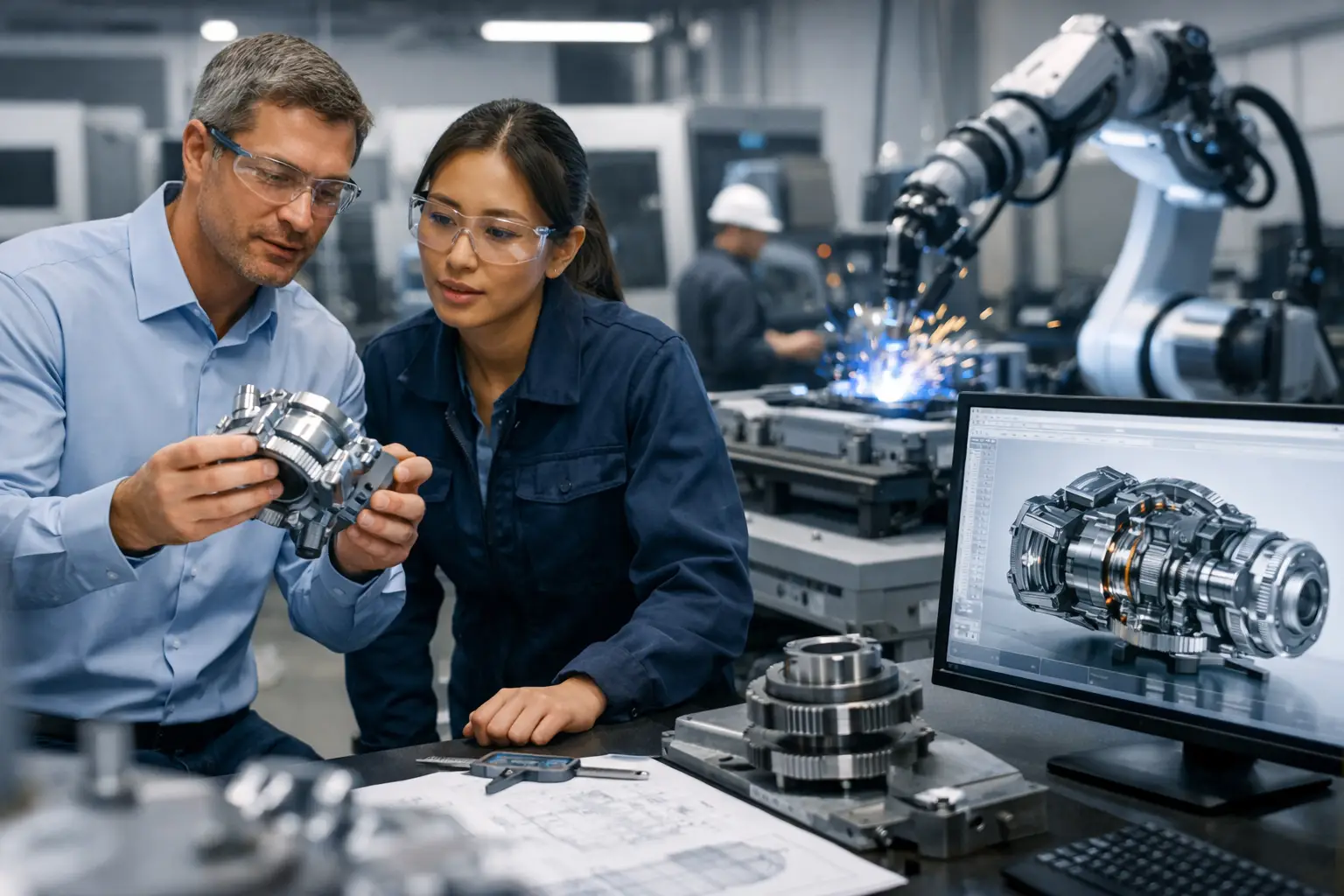
A prototype that looks impressive on a workbench can still fail the moment production begins. Parts may cost too much, tolerances may be unrealistic, assembly may take too long, or a supplier may be unable to deliver consistent quality. That is where manufacturing engineering firms make a measurable difference: they help turn a promising product idea into something that can be built repeatedly, affordably, and at the quality customers expect.
For inventors, startup founders, and established businesses, the challenge is rarely just having a good idea. The real work is closing the gap between an idea, a functional prototype, and a product that can survive real-world manufacturing. A capable engineering partner brings structure to that process while protecting the purpose of the original concept.
What Manufacturing Engineering Firms Actually Do
Manufacturing engineering is the discipline of preparing a product and its production process for the real world. It looks beyond whether a prototype works once. It asks whether the product can be made hundreds or thousands of times without creating unnecessary cost, quality problems, delays, or customer returns.
A manufacturing engineering firm may support product design, material selection, component sourcing, tooling decisions, assembly methods, production documentation, quality controls, and supplier communication. The exact scope depends on where a client is in the development cycle. An entrepreneur with a rough sketch needs a different level of support than a company that already has a tested prototype but cannot produce it reliably.
The best firms do not treat manufacturing as an afterthought. They bring production realities into the development process early, when changes are faster and less expensive. A small adjustment to a housing wall thickness, fastener choice, circuit-board layout, or assembly sequence can prevent a major problem later.
Prototype Success Is Not Production Readiness
Early prototypes are built to answer important questions: Does the idea work? Is the user experience right? Can the core mechanism perform as intended? These are necessary milestones, but prototype materials and methods are often not appropriate for commercial production.
For example, a 3D-printed enclosure may validate a product’s size and shape, yet injection molding may require redesigned walls, draft angles, ribs, and parting lines. A hand-assembled electronic prototype can prove a circuit, while a production unit needs a repeatable assembly process, test procedures, documented components, and supply-chain alternatives.
That transition is where practical engineering judgment matters. The goal is not to make a product more complicated. It is to preserve what makes it valuable while removing barriers to making it at scale.
How Manufacturing Engineering Firms Reduce Risk
Product development involves trade-offs. Higher-grade materials can improve durability but raise unit costs. Tighter tolerances may improve fit but require more expensive fabrication. A lower-cost component may be available today but create supply concerns six months from now. There is no universal right answer, which is why decisions should be based on the product’s market, expected volume, target price, and performance requirements.
Manufacturing engineering helps clients make those decisions before money is committed to tooling, inventory, or a production run. Instead of discovering problems through expensive trial and error, teams can identify likely issues through design reviews, prototype testing, cost analysis, and early supplier input.
This work often focuses on four connected areas:
- Design for manufacturability, which simplifies parts and features so they can be produced consistently.
- Design for assembly, which reduces unnecessary steps, difficult alignment, and opportunities for human error.
- Design for quality, which identifies critical dimensions, test points, and inspection requirements.
- Design for cost, which evaluates materials, processes, labor, tooling, packaging, and expected production volume.
These disciplines should not be viewed as restrictions on invention. They are the practical framework that helps an invention become a business asset.
Cost Is More Than the Price of One Part
A common mistake is choosing the least expensive component or fabrication quote without evaluating the total manufacturing picture. A low-cost part that is hard to assemble, frequently damaged, or inconsistent from batch to batch can quickly become the more expensive option.
True product cost includes labor, scrap, testing, shipping, packaging, warranty exposure, rework, tooling, lead times, and inventory risk. It also includes the cost of delay. If a design cannot be produced on schedule, a product launch can miss a critical market window.
A manufacturing-focused engineering team evaluates these factors together. Sometimes the right choice is a more expensive component that reduces assembly time and field failures. Other times, a design change can eliminate an entire part and improve both reliability and cost.
When to Bring Manufacturing Engineering Into Your Project
The short answer is earlier than most people think. If you wait until a prototype is complete to consider how it will be manufactured, you may have to redesign key features under pressure. Early manufacturing input is especially valuable when a product includes moving parts, electronics, molded components, custom mechanisms, tight dimensional requirements, or planned production volumes beyond a small pilot run.
That does not mean every idea needs factory-level documentation on day one. Early-stage concepts need room to evolve. The right approach is progressive: validate the product’s core function first, then increase engineering detail as the design becomes more certain.
For many clients, a sensible path looks like this:
- Define the concept, intended user, key features, and commercial objective.
- Create models and prototypes that test function, form, and usability.
- Review the design for manufacturability before finalizing expensive decisions.
- Prepare production-ready files, specifications, testing criteria, and supplier requirements.
- Build and evaluate pilot units before committing to broader production.
Each stage reduces uncertainty. Skipping stages may feel faster, but it often transfers risk to the most expensive point in the project.
Choosing Among Manufacturing Engineering Firms
Not every engineering provider is built for the same type of project. Some firms specialize in high-volume industrial systems, while others focus on consumer goods, medical devices, electronics, or early-stage inventions. The right fit depends on your product, your budget, your production goals, and how much development has already been completed.
Start by looking for a team that can explain its process in practical terms. You should understand what will be designed, tested, documented, and delivered at each phase. Vague promises of taking an idea to market are not enough. Ask how the firm approaches prototype iteration, design changes, production handoff, supplier coordination, and quality planning.
It is also wise to evaluate whether the firm understands intellectual property considerations. A prototype can support patent-related strategy when it clearly demonstrates how an invention works. At the same time, engineering decisions should be documented carefully so that the product’s novel features are not lost during redesign for manufacturing.
Industry of Concepts LLC supports this bridge between concept development, functional prototyping, engineering, manufacturing preparation, and patent-oriented product development. For a founder without an in-house technical team, having connected expertise under one roof can reduce miscommunication and keep the project moving with a clearer purpose.
Questions Worth Asking Before You Commit
Before selecting a partner, ask whether they have experience with products similar in complexity to yours, but do not rely on similarity alone. A good engineering firm should also be able to identify what is unique about your product and what could create production risk.
Ask how they manage revisions, how they estimate development costs, what prototype methods they recommend, and when they involve potential manufacturers. You should also know who owns the design files, documentation, and intellectual property created during the engagement. Clear ownership and clear communication are essential from the start.
Most importantly, choose a partner willing to give you an honest answer. If a feature is too costly, too fragile, or difficult to manufacture at your intended price, you need to know early. Constructive engineering feedback protects the project, even when it requires a change in direction.
Build for the Market You Want to Reach
The best production strategy depends on the market opportunity. A limited-run specialty product may justify different materials and processes than a mass-market consumer product. A startup preparing for its first pilot order needs flexibility and learning opportunities. A business with established demand may prioritize automation, cycle time, and supply continuity.
Manufacturing engineering creates a path from what is possible to what is repeatable. It gives inventors and businesses a stronger basis for budgeting, protecting their ideas, speaking with suppliers, and preparing for growth. Your concept deserves more than a one-time prototype. It deserves the engineering discipline to become a product people can buy, use, and trust.