A promising idea is not yet a product, and a product is not automatically a business. The main reason for product development is to turn a meaningful customer problem into a solution people will choose, use, and pay for. Growth follows when that solution can be produced reliably, protected appropriately, and delivered at a price the market accepts.
For inventors and founders, this distinction matters. It is easy to become attached to an idea because it is clever, technically impressive, or personally important. But successful development begins with a harder question: Who has this problem, how do they handle it now, and why would they switch to your solution?
The Main Reason for Product Development Is Customer Value
Product development exists to create value that did not exist before, or to deliver existing value in a better way. That can mean reducing time, improving safety, lowering cost, increasing convenience, or making a difficult task possible. The product itself is the vehicle. The customer outcome is the reason it matters.
Consider a founder with an idea for a kitchen tool. The opportunity is not simply to make a new object. It is to help people prepare food faster, avoid waste, clean up more easily, or complete a task they currently find frustrating. If the tool does not deliver a noticeable advantage, even excellent engineering may not create demand.
This is why product development is not just a design exercise. It is a commercial decision supported by design, engineering, prototyping, manufacturing planning, and intellectual property strategy. Each stage should reduce uncertainty about whether the product can succeed.
Growth Comes From Solving a Problem Better
A new product can support growth in several ways. A startup may use it to enter a market. An established company may use it to reach a new customer segment, defend against competitors, improve margins, or create repeat purchases. An independent inventor may use it to build a licensable asset or launch a business.
The path depends on the opportunity, but the standard remains the same: the product must solve a problem well enough to earn attention and adoption. A product that is only different may struggle. A product that is clearly better has a stronger reason to exist.
“Better” does not always mean more features. In many categories, the winning product is simpler, easier to understand, less expensive to manufacture, or more dependable in real use. Adding features can raise development costs, complicate production, increase failure points, and make a product harder to explain. The right answer depends on what customers value most.
Start With the Existing Alternative
Every product has competition, even if no company sells an identical item. The competition may be a manual workaround, an older device, a service provider, or the customer doing nothing at all.
Before investing heavily in development, define that alternative clearly. Ask what customers dislike about it, what it costs them in time or money, and what would persuade them to change. These answers help shape the product requirements long before a prototype is built.
For example, if buyers care most about speed, an elegant but slow mechanism will miss the mark. If they care about durability, a low-cost material selection may undermine the whole concept. Product decisions need to reflect the real buying decision, not assumptions made in a workshop or conference room.
Development Turns an Idea Into Evidence
A sketch can communicate a vision. A functional prototype can test whether that vision works. This is one of the most valuable purposes of professional product development: it replaces opinions with evidence.
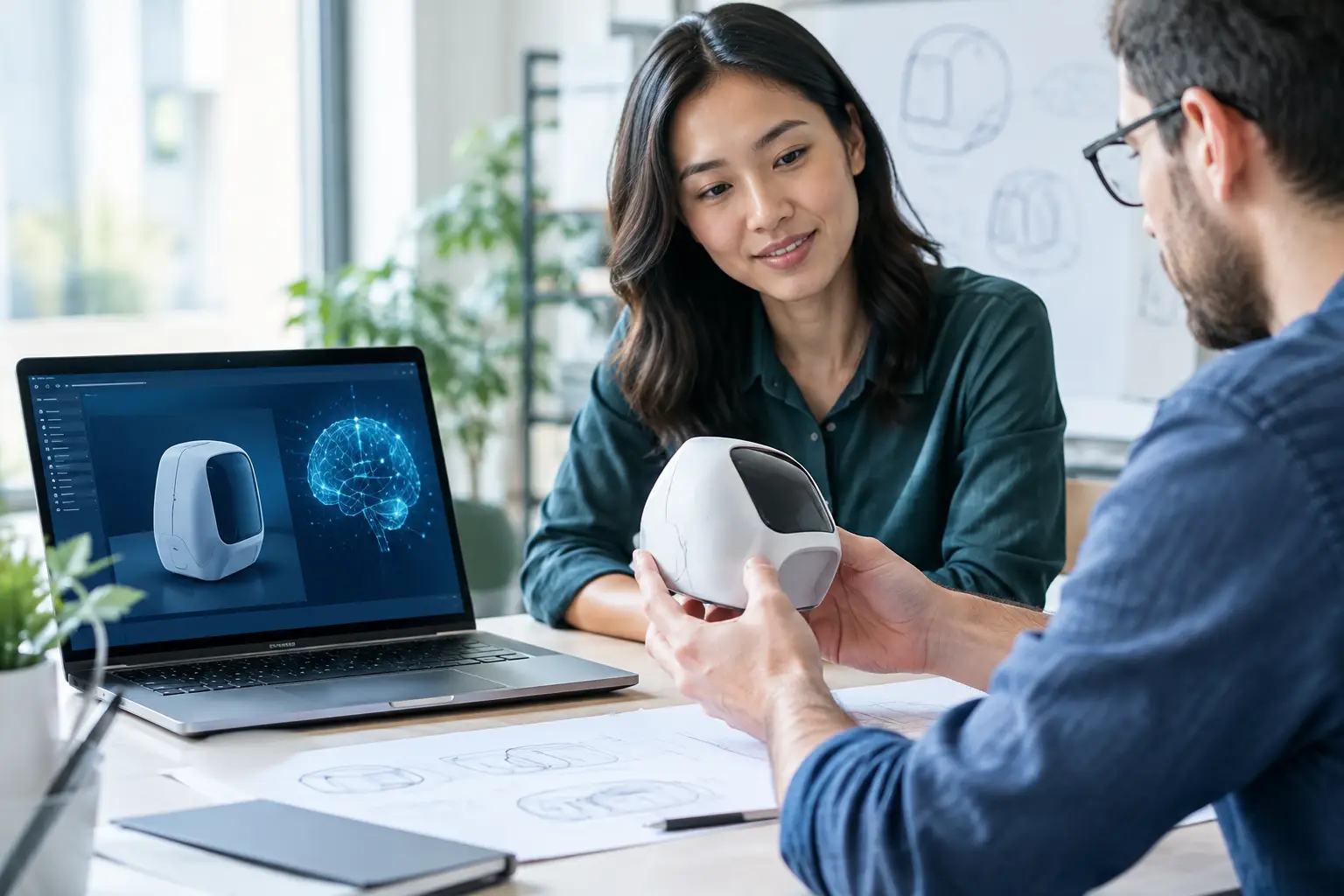
Early concept development helps identify the product’s essential function, user interaction, physical form, and likely technical risks. Computer modeling then allows dimensions, mechanisms, assemblies, and materials to be evaluated before expensive tooling is considered. Rapid prototypes make the concept tangible, allowing users, investors, partners, and engineers to react to something real.
A prototype does not need to look like a finished retail product to be valuable. In many cases, its job is to prove a specific function, test ergonomics, show a mechanism, or demonstrate that a technical approach is feasible. A proof-of-concept prototype can also provide useful support for patent-related discussions by documenting the invention in physical form.
The key is building the right prototype for the question you need answered. A rough model may be enough to test hand feel. A more advanced electro-mechanical prototype may be necessary to validate performance, power requirements, sensors, controls, or repeated use. Spending should match the risk being reduced.
Product Development Must Balance Four Realities
A market-ready product sits at the intersection of customer demand, technical feasibility, manufacturability, and business economics. Ignoring any one of these realities can create expensive setbacks later.
Customer demand asks whether the product solves a problem people care about. Technical feasibility asks whether it can perform consistently and safely. Manufacturability asks whether it can be made at a practical scale with achievable quality. Business economics asks whether the sales price, production cost, distribution costs, and expected demand can support the venture.
These factors often pull in different directions. A premium material may improve performance but damage the margin. A complex mechanism may create a stronger patent position but raise assembly costs. A lower-cost manufacturing process may require changes to geometry, tolerances, or appearance. These are not reasons to stop developing. They are reasons to make decisions early, while changes are still affordable.
Avoid the “Prototype Trap”
Many inventors reach an exciting milestone when the first prototype works, then assume the product is ready for production. Usually, it is not. A prototype may rely on 3D-printed parts, hand assembly, temporary electronics, or materials that cannot be used economically in volume.
Manufacturing engineering bridges that gap. It addresses part design, tolerances, materials, assembly methods, supplier requirements, quality checks, and production cost. The goal is not merely to make one working unit. It is to create a repeatable process capable of producing many units that perform as intended.
That transition is where a great concept can either become a viable product or reveal weaknesses that need to be addressed. Planning for manufacturing from the beginning prevents a painful redesign after time and money have already been invested.
Protect What Creates the Advantage
The main reason for product development is growth, but ownership affects who benefits from that growth. If your product includes a novel mechanism, functional system, ornamental design, or technical improvement, intellectual property should be part of the development conversation early.
Patent strategy is not a substitute for a strong product. It cannot create demand where no customer need exists. However, it can help protect meaningful innovation, strengthen investor or licensing conversations, and make it harder for competitors to copy what makes the product valuable.
Careful documentation matters. Design files, development records, prototype iterations, and clear descriptions of how the invention works can all support a more organized path toward patent-related action. Public disclosure timing also matters, so inventors should think about protection before showing details broadly at trade events, online, or in sales discussions.
Move Forward With a Development Plan
The most efficient product development programs do not attempt to solve everything at once. They define the opportunity, identify the highest risks, and work through them in a deliberate sequence. One stage should create the information needed to make the next decision with confidence.
For a first-time inventor, that may mean beginning with concept refinement and a proof-of-concept prototype. For a startup preparing to raise capital, it may mean producing a credible functional demonstration and preliminary manufacturing estimates. For an established business, it may mean redesigning an existing product to reduce cost or add a market-driven improvement.
Industry of Concepts helps clients connect these stages, from early ideas and industrial design through engineering, prototypes, manufacturing preparation, and patent-oriented support. The purpose is practical: help turn uncertainty into a product path that can be tested, protected, and pursued.
Do not waste a good idea by rushing straight to production or leaving it as a sketch. Build enough evidence to know what customers need, what the product must do, and what it will take to bring it to market. That is how an idea becomes an asset with a real chance to grow.