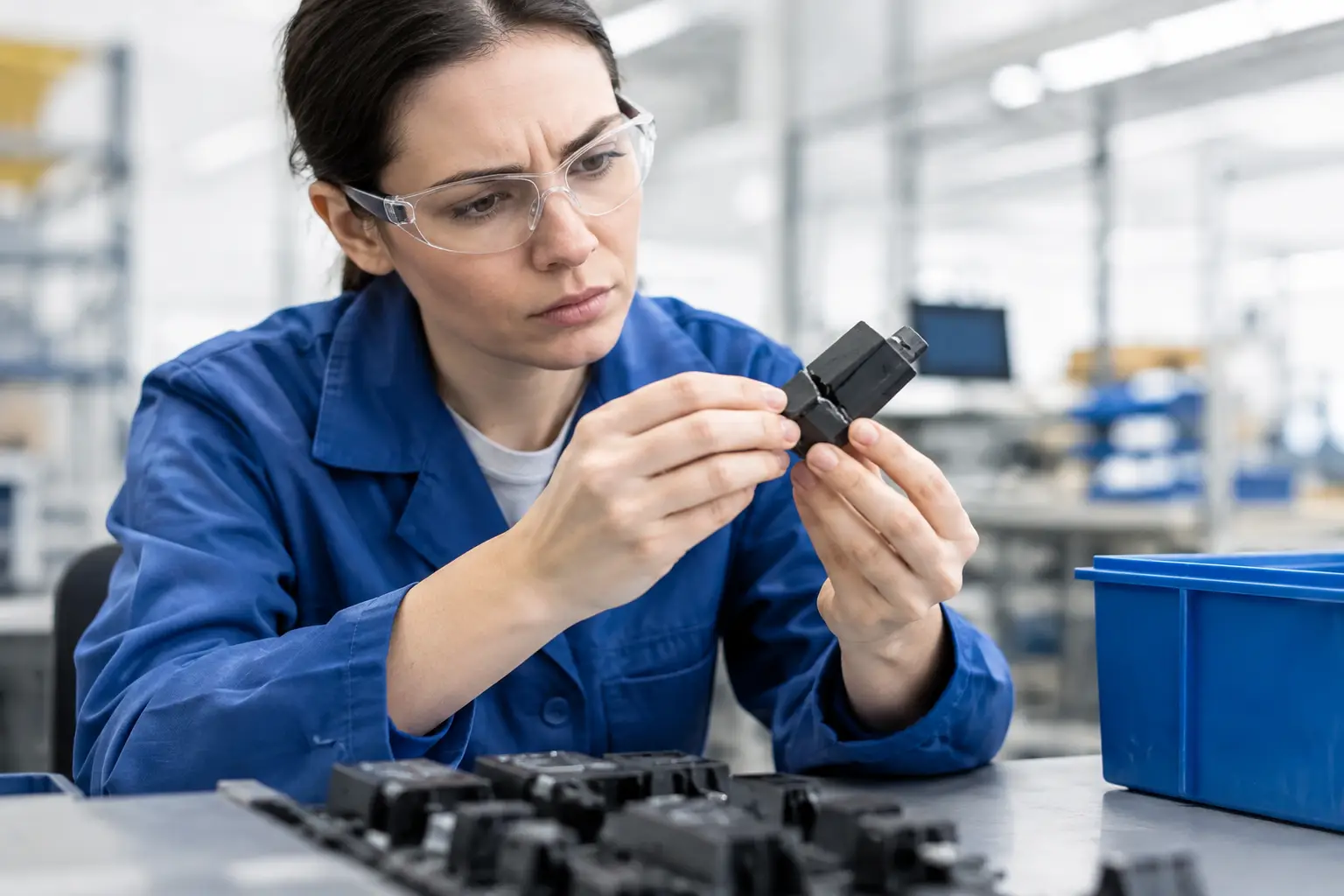
A prototype works perfectly on a workbench. Then the first production run arrives with warped parts, inconsistent assembly, missed delivery dates, and costs that erase the planned margin. When founders ask, “why do products fail manufacturing?” they are usually looking at the wrong moment. The failure often began much earlier, when a promising concept was not fully prepared for the realities of production.
Manufacturing is not simply the final step after design. It is a technical discipline with its own constraints: material behavior, tolerances, tooling, suppliers, assembly methods, testing, packaging, labor, and quality controls. A product can be innovative, patentable, and functional while still being difficult or uneconomical to build at scale.
The good news is that most manufacturing failures are preventable. They are not a reason to abandon a strong idea. They are a reason to bring manufacturing thinking into product development before expensive commitments are made.
Why Do Products Fail in Manufacturing?
Products fail in manufacturing when the design, the production process, and the business plan do not agree with one another. A design may require precision that the selected supplier cannot hold. A component may work in a prototype but become unavailable or too expensive at production volumes. An assembly may take ten minutes by hand when the target cost only allows for two.
The central challenge is that prototypes and manufactured products answer different questions. A prototype proves that an idea can work. A production-ready design proves it can be made repeatedly, safely, consistently, and profitably.
1. The design was never built for manufacturing
This is one of the most common and costly problems. Early prototypes are often made with 3D printing, CNC machining, off-the-shelf hardware, and skilled hand assembly. Those methods are valuable because they let inventors test function quickly. But they can hide issues that appear when thousands of units must be produced.
For example, a plastic housing may look excellent when 3D printed but may be impossible to mold without redesigning wall thicknesses, draft angles, ribs, undercuts, and parting lines. A tight fit between two components may work once but become unreliable when normal material variation is introduced.
Design for manufacturing means reviewing the product through the eyes of the factory. How will each part be formed? How will it be located during assembly? What tolerances are truly necessary? Can the product be assembled incorrectly? These questions should shape the design before tooling begins, not after the first run fails.
2. A prototype was mistaken for a production specification
A proof-of-concept prototype can demonstrate a mechanism, an electronic function, or a user experience. It does not automatically contain the documentation needed to manufacture the product accurately.
Factories need clear drawings, material specifications, bills of materials, assembly instructions, finish requirements, test procedures, and approved samples. If these are vague, the manufacturer will fill in the gaps. That may lead to substitutions, inconsistent quality, or misunderstandings that are expensive to correct.
A strong production package reduces interpretation. It tells the supplier what matters most and where there is flexibility. This distinction protects both sides: the manufacturer has a workable standard, and the product owner has a measurable basis for quality approval.
3. Materials and components were selected too early
A product may depend on a particular resin, motor, sensor, battery, fastener, or adhesive that is ideal in theory but difficult to source reliably. In some cases, a custom component appears affordable at low volume but carries long lead times, high minimum order quantities, or unpredictable availability at scale.
Material selection also affects performance in ways a quick prototype may not reveal. Plastics can shrink, creep, discolor, crack under stress, or react poorly to heat and chemicals. Metals can corrode or create unexpected weight and cost problems. Electronics may require redesign when a part becomes obsolete.
The best choice depends on the product’s expected volume, environment, price point, regulatory needs, and planned lifecycle. There is no universal “best” material. A manufacturing-ready design includes alternatives for critical parts and avoids single-source risk whenever practical.
4. Tolerances are either too loose or too tight
Tolerance is the acceptable range of variation in a dimension. It sounds like a small detail, but it has a major effect on fit, function, yield, and cost.
If tolerances are too loose, components may rattle, leak, bind, or fail to align. If they are too tight, parts may require costly processes, frequent inspection, or rejection rates that make the product unprofitable. Many first-time product teams specify tight tolerances because precision feels safer. In manufacturing, unnecessary precision is often an avoidable expense.
Tolerance stack-up matters even more in assemblies. Several individually acceptable parts can combine in a way that creates a bad fit. Engineering analysis and pilot builds identify where variation accumulates and where the design needs more forgiveness.
5. The assembly process was underestimated
A product with only a few parts can still be difficult to assemble. The issue may be orientation, access for tools, fragile wires, complex fastening, adhesive cure time, or a step that requires unusually skilled labor.
Every extra action adds time, cost, and opportunity for error. A design that requires an operator to hold three pieces in place while installing a tiny screw may work in a development shop. On a production line, it can become a bottleneck.
Good manufacturing engineering simplifies the sequence. Features such as locating pins, self-aligning geometry, captive fasteners, keyed connectors, and error-proof assembly steps can improve both speed and quality. The goal is not merely to make assembly possible. It is to make correct assembly repeatable.
6. Quality was inspected in, not designed in
Final inspection cannot rescue a product with an unstable process. If a factory must sort good units from bad units at the end of the line, the product is already carrying unnecessary scrap, rework, and delay.
Quality needs to be built into the design and process. That includes defining critical-to-quality features, setting practical acceptance criteria, establishing incoming inspection for high-risk parts, and creating functional tests that catch real failures. It also means deciding what an approved “golden sample” looks and feels like.
Not every product needs the same level of testing. A simple consumer accessory and a safety-related electro-mechanical device carry very different risks. The important point is to match the quality plan to the product’s function, customer expectations, and consequences of failure.
7. Cost targets were treated as estimates, not engineering limits
A retail price does not determine whether a product can be made profitably. The real calculation includes materials, labor, tooling amortization, scrap, packaging, freight, testing, certification, distributor margins, returns, and warranty exposure.
Teams often discover too late that their target manufacturing cost leaves no room for reality. Then they are forced into rushed redesigns, lower-quality substitutions, or a launch price the market will not accept.
Cost should be reviewed throughout development. Early estimates may be broad, but each prototype cycle should improve the picture. Sometimes the right move is to simplify the product. Sometimes it is to raise the price, change the production method, or build a higher-value version for a narrower market. Those are strategic decisions, not merely purchasing decisions.
8. Scale-up happened without a disciplined pilot run
The jump from one working unit to hundreds or thousands is where hidden problems become visible. A pilot run is the controlled bridge between development and full production. It tests tooling, supplier communication, assembly time, quality checks, packaging, and logistics under real conditions.
Skipping this stage may seem faster, especially when a launch date is approaching. Usually, it simply moves risk into a larger and more expensive batch. A pilot run creates the opportunity to document defects, adjust fixtures, improve work instructions, and confirm that the cost model reflects actual output.
Prevent Manufacturing Problems Before They Start
The most effective product teams involve engineering, industrial design, sourcing, and manufacturing expertise early. They test the product’s function, but they also test its producibility. They challenge assumptions before money is locked into tooling and inventory.
For inventors and startup founders, this does not mean you need to become a manufacturing expert overnight. It means you need a development path that turns your idea into more than an impressive prototype. At Industry of Concepts, that path can include concept development, engineering validation, prototyping, manufacturing preparation, and patent-oriented support so important decisions are made with the complete product in view.
A product deserves more than a first unit that works. Before committing to production, ask whether it can be built consistently by real people, with real materials, at a cost that supports the business. That question can protect your budget, your timeline, and the value of the idea you worked hard to create.