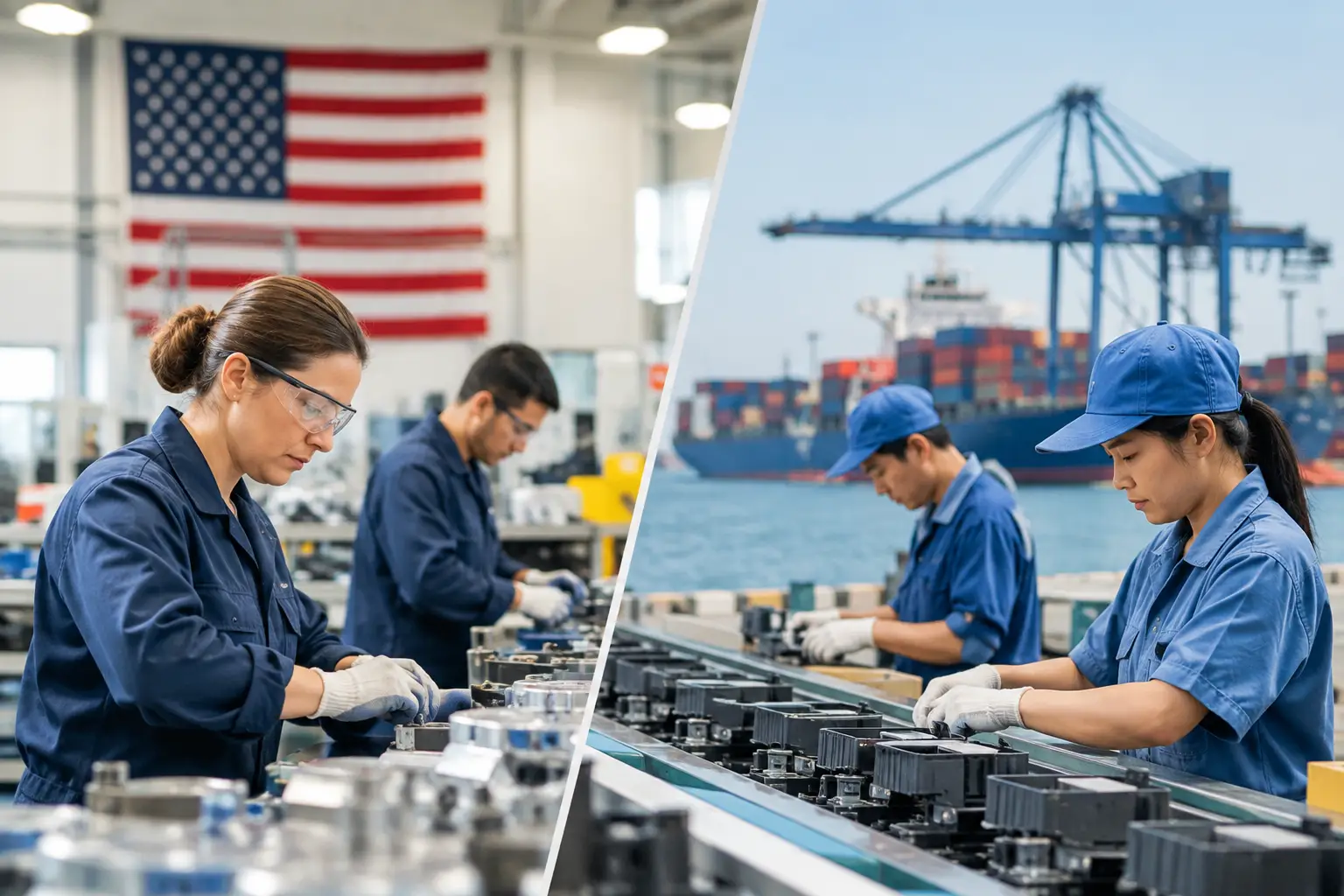
A prototype can perform perfectly on your workbench and still fail as a business if the manufacturing plan does not match the product. The domestic versus offshore manufacturing decision affects your cash requirements, launch schedule, quality standards, intellectual property exposure, and ability to respond when something goes wrong. For inventors and founders, this is not a simple question of finding the lowest unit price. It is a decision about how much control your product needs while it becomes a real business.
A lower quote may look compelling until freight, tooling changes, rejected parts, inventory carrying costs, and delayed revisions enter the picture. On the other hand, producing close to home is not automatically the right answer for every product. The strongest choice depends on your product complexity, expected volume, timeline, funding, and tolerance for risk.
Domestic Versus Offshore Manufacturing: Start With the Product
Before comparing factory locations, make sure the product is ready to manufacture. A functional prototype proves that an idea can work. A manufacturing-ready design proves it can be made repeatedly, assembled efficiently, tested reliably, packaged safely, and sold at a sustainable margin.
This distinction matters because an early design often changes after production feedback. Tolerances may be too tight. A plastic part may need a different wall thickness. An electronic component may become unavailable. An assembly step may take too long. When those changes are likely, close communication with a manufacturing partner can be more valuable than a low initial quote.
Domestic manufacturing often makes sense during early production runs, especially for products that are mechanically complex, highly regulated, customized, or still evolving. A nearby supplier can make it easier to visit the facility, inspect first articles, solve issues in person, and keep design intent intact. For a New York inventor, that may mean working with suppliers in the Northeast or elsewhere in the United States where collaboration is more practical.
Offshore manufacturing can be highly effective when the design is stable, the supply chain is established, and volumes are high enough to justify the coordination. Many overseas manufacturing regions offer deep expertise in specific categories, from molded consumer goods and metal fabrication to electronics and high-volume assembly. The opportunity is real, but it requires preparation and oversight.
Cost Is More Than the Per-Unit Quote
Offshore production is often associated with lower labor costs and lower per-unit pricing. For products with large volumes, labor-intensive assembly, or mature tooling, those savings can be meaningful. If a product has a predictable sales channel and demand supports larger orders, offshore manufacturing may improve margins significantly.
But landed cost is the number that matters. Landed cost includes the factory price plus tooling, packaging, freight, tariffs or duties where applicable, insurance, customs handling, quality inspections, storage, and the cost of carrying inventory while it is in transit. It also includes the financial impact of committing to a larger minimum order quantity before the market has fully validated the product.
Domestic suppliers may quote a higher unit price, but they can reduce hidden costs. Smaller order quantities can preserve cash. Shorter shipping distances can reduce inventory needs. Faster replenishment can prevent stockouts without forcing you to warehouse months of product. A local partner may also make it easier to revise tooling or correct a production problem before it becomes an expensive container-load mistake.
For a startup, the right question is not, What is the cheapest factory? Ask, What path gives this product the best chance of reaching customers at a profit without tying up too much cash?
Lead Time Can Decide Your Launch Window
When manufacturing is domestic, communication usually happens within similar working hours, shipments arrive more quickly, and factory visits are possible without international travel. Those factors can shorten development loops and make a limited launch more achievable. If you need to test the market, fulfill an early retail opportunity, or restock quickly after a successful campaign, speed may outweigh a lower unit cost.
Offshore production generally requires more planning. Ocean freight, customs clearance, production queue times, and holiday shutdowns can extend the schedule. Air freight can solve an urgent problem, but it can erase much of the expected cost advantage. A realistic offshore timeline must include sampling, tooling, pre-production approval, manufacturing, inspection, transit, and receiving inventory.
That does not make offshore lead times unacceptable. It means they must be built into the business plan. Products with seasonal demand need even more caution. A delayed shipment of a holiday item, school-season product, or event-based launch can have consequences far beyond the original production delay.
Revision Speed Matters in Early Production
The first manufacturing run is often where a product teaches you what the CAD model could not. A latch may need more force. Instructions may confuse customers. Packaging may not protect the product well enough. These discoveries are normal, not signs of failure.
Domestic production can give founders the ability to make smaller adjustments between runs and move quickly. Offshore production can still support revisions, but the process requires stronger documentation, clearer approvals, and more time. If your product is still being refined, consider whether a domestic pilot run can reduce risk before you scale.
Quality Control Requires Systems, Not Assumptions
Quality problems are not limited to any country or any type of supplier. They usually come from unclear specifications, incomplete drawings, inconsistent materials, weak inspection plans, or assumptions that a factory understands the intended result.
A capable manufacturer needs clear documentation: dimensioned drawings, material requirements, finish specifications, approved component lists, assembly instructions, test procedures, packaging requirements, and acceptable quality limits. For electronics or electro-mechanical products, documentation should also address firmware versions, test fixtures, wire routing, safety requirements, and traceability where needed.
Domestic suppliers can offer easier access when a quality issue appears. You may be able to inspect production, participate in a first-article review, or speak directly with the people building the product. Offshore manufacturing may require third-party inspections, local quality staff, or a trusted sourcing partner to maintain the same level of oversight.
The practical lesson is simple: do not send a concept sketch and expect production-grade consistency. Invest in engineering documentation before requesting final quotes. Better documentation protects quality regardless of where the factory is located.
Intellectual Property Needs Deliberate Protection
Inventors are right to think carefully about intellectual property when discussing manufacturing. A patent application, trademark strategy, non-disclosure agreement, and well-managed release of technical information can all play a role. However, no single document replaces a thoughtful product-development process.
Domestic manufacturing may feel more comfortable because communication, legal systems, and enforcement are closer to home. That proximity can be useful, particularly for proprietary mechanisms, specialized processes, or products with significant commercial value. Yet domestic production does not remove the need for confidentiality controls and clear ownership agreements.
Offshore manufacturing requires additional discipline. Share only the information necessary for each supplier to perform its role. Maintain control of design files, source code, tooling ownership terms, bills of materials, and approved revisions. Work with suppliers that have a track record in your product category and establish written expectations before production begins.
For many founders, the best protection starts earlier: build a well-documented proof of concept, pursue appropriate patent guidance, and avoid rushing into broad supplier discussions before the product strategy is defined.
When a Hybrid Approach Makes Sense
The decision does not have to be all domestic or all offshore. A hybrid strategy can balance speed, control, and cost. For example, a company might develop prototypes and complete early pilot runs in the United States, then move stable, validated components to an offshore supplier as demand grows. Another product may use domestic final assembly and testing while sourcing standardized components globally.
This approach is especially useful when the product contains a proprietary core but also uses commodity parts. It lets you keep sensitive work and customer-facing quality control close while using global supply options where they make financial sense.
The key is to plan the transition from the beginning. Design choices, tooling ownership, component availability, and documentation standards should support the scale you intend to reach. A product developed without manufacturing strategy can become costly to move later.
Make the Decision With Real Production Data
Before selecting a manufacturing path, compare more than estimates. Request quotes based on the same drawings, quantities, materials, tooling assumptions, packaging, and quality requirements. Ask each supplier about minimum order quantities, lead times, payment terms, tooling ownership, sample approval, inspection procedures, and capacity for future growth.
Then evaluate the result against your actual business stage. If you are validating demand, flexibility may be worth paying for. If you have committed orders and a stable design, volume economics may carry more weight. If the product has complex engineering or meaningful IP, control and documentation should move higher on the list.
Industry of Concepts helps inventors and product entrepreneurs turn early ideas into functional, manufacturing-ready products, so these decisions can be made with stronger technical information rather than guesswork. The right manufacturing location is the one that supports your next milestone without creating avoidable risk. Build the product carefully, document it thoroughly, and choose the production path that gives your idea room to grow.