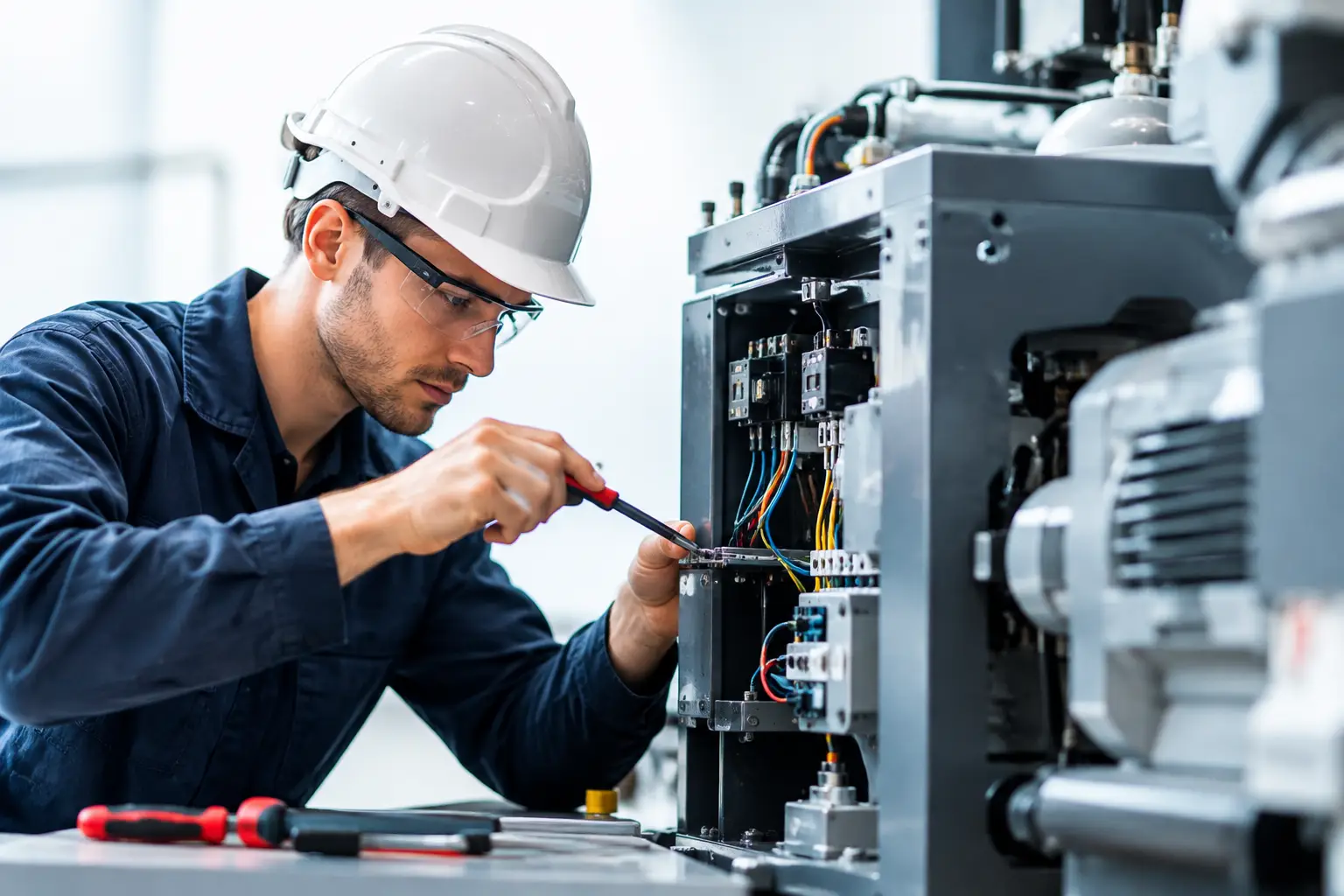
A product can look convincing in a sketch and still fail the moment it needs to move, sense, switch, charge, lock, dispense, or survive repeated use. That is where electro mechanical engineering services become essential. They turn an idea with moving parts and electronics into a working system that can be tested, improved, protected, and prepared for production.
For inventors and growing businesses, the goal is not simply to build something that powers on once. The goal is to create a prototype that proves the product’s value, identifies technical risks early, and gives you a credible foundation for patent support, investor discussions, manufacturing quotes, and market planning.
What Electro Mechanical Engineering Services Actually Do
Electro-mechanical product development sits at the intersection of physical design and electrical function. It applies when a product includes both mechanical components and electrical systems, such as motors, sensors, batteries, switches, circuit boards, actuators, heating elements, lighting, or controls.
A consumer device with a motorized mechanism, a smart household tool, a portable medical accessory, an automated fixture, or a specialty industrial product may all require electro-mechanical engineering. The work is not limited to choosing components. It is about making those components operate together reliably inside a product that people can use and manufacturers can build.
The process often includes mechanical design, 3D CAD modeling, component selection, electrical architecture, enclosure development, prototype assembly, testing, and design changes based on what the prototype reveals. Depending on the product, it can also involve embedded controls, battery management, thermal considerations, wiring layouts, safety features, and manufacturing documentation.
The exact scope depends on the idea. A simple battery-powered device may need a focused proof-of-concept prototype. A product with motion, user controls, wireless functions, and custom electronics may require a more detailed engineering plan before prototype fabrication begins.
Why Engineering Decisions Matter Before Manufacturing
Many product ideas run into trouble because design decisions are made in the wrong order. An inventor may start with the exterior appearance, purchase off-the-shelf parts, or build a rough model before confirming whether the mechanical and electrical systems can fit, function, and be produced at a reasonable cost.
That approach can create expensive rework later. A motor may not provide enough torque. A battery may be too large for the enclosure. A sensor may give inaccurate readings because of its position. Wiring may interfere with moving parts. A housing may look clean but be impossible to assemble efficiently.
Professional electro mechanical engineering services address these questions before they become tooling costs, failed production runs, or lost time. Engineering does not eliminate every risk, but it gives you a disciplined way to find the right risks early, when changes are less expensive.
A functional prototype also provides answers that drawings alone cannot. It shows whether the mechanism behaves as expected, whether users can understand the controls, whether the product feels practical in the hand, and whether its core feature performs consistently. Those answers help an entrepreneur make better decisions about where to invest next.
The Path From Product Idea to Functional Prototype
Start With the Product’s Core Proof Point
The first engineering question is not, “What features can we add?” It is, “What must this product prove?” For some products, the central proof point is a moving mechanism. For others, it may be a sensing function, a locking action, a charging system, or a controlled dispensing process.
Defining that proof point keeps early development focused. It prevents money from being spent too soon on cosmetic details, unnecessary features, or highly polished parts before the central function is validated. A good prototype is built to answer specific questions, not merely to look finished.
Clear requirements also protect the project from drifting. Engineers need to understand the intended user, use environment, target size, power source, expected duty cycle, desired price range, and any performance limits that could affect the design. A device intended for occasional home use will be engineered differently than equipment expected to operate all day in a commercial setting.
Engineer the Mechanical and Electrical Interfaces
The hardest problems in electro-mechanical products often occur where systems meet. The motor has to fit the mechanical assembly. The controls need to communicate with the electrical hardware. The battery, circuit board, fasteners, sensors, and wiring all need physical space without blocking movement or making assembly difficult.
This is why integrated engineering matters. A mechanical design cannot be finalized without considering electronic components, and electronics cannot be selected without understanding the loads, space constraints, heat, movement, and operating conditions of the mechanical system.
During this stage, engineers evaluate practical trade-offs. A smaller motor may reduce size and cost but deliver less force. A larger battery may extend run time but make the product heavier. A custom component may improve performance but add development time and minimum-order requirements. There is rarely one perfect choice. The right choice supports the product’s purpose, budget, and path to market.
Build, Test, and Learn From the Prototype
A prototype is a learning tool. It should be tested in ways that reflect how the product will actually be used. That may mean repeated cycling of a moving part, checking response times, measuring battery performance, evaluating heat, testing user controls, or examining how parts hold up after assembly and disassembly.
Early prototypes may use 3D-printed parts, readily available electronics, hand-built assemblies, and temporary fixtures. That is often the sensible approach because it makes changes faster. Production-ready materials and processes can come later, once the product’s main function has been demonstrated.
Testing commonly exposes issues that were not obvious in CAD. A part may flex too much. A latch may require more force than expected. A wire may fatigue after repeated movement. An enclosure may amplify sound or vibration. These findings are not failures of the process. They are the reason to prototype before committing to manufacturing.
Prepare for the Next Business Decision
Once a prototype works, the next step depends on the client’s goal. Some inventors need a proof-of-concept model to support patent strategy. Others need a more refined prototype for investor presentations, customer feedback, licensing discussions, or manufacturing evaluation.
For a product moving toward production, engineering shifts toward material choices, assembly methods, component availability, tolerances, cost targets, and supplier requirements. A prototype that works on a bench is valuable, but a product that can be assembled consistently at an acceptable cost is what creates a viable business opportunity.
Common Problems That Delay Electro-Mechanical Products
One common mistake is treating electrical hardware as an afterthought. When electronics are added after the enclosure and mechanism are already designed, the team may discover that there is no usable space for the battery, board, connectors, or wiring. The result is often a larger, more complicated, and more expensive redesign.
Another problem is overbuilding the first prototype. It is tempting to pursue a polished product immediately, especially when the idea has been in development for a long time. Yet an early prototype should focus on the biggest unknowns. It may not need final materials, full app connectivity, custom packaging, or every planned feature to validate the business-critical function.
A third issue is designing without a manufacturing path in mind. Some prototype methods are excellent for early testing but unsuitable for volume production. That is not a reason to avoid them. It is a reason to understand the difference between a proof-of-concept, an engineering prototype, and a production-intent design.
Patent Support and Engineering Should Inform Each Other
For many inventors, a prototype is more than a development milestone. It can help explain how an invention works, demonstrate its novel features, and support more productive conversations around intellectual property strategy.
Engineering and patent-oriented development should be coordinated from the beginning. As a product is developed, the team can identify which mechanisms, arrangements, functions, and user interactions may be central to the invention. This does not replace legal advice from a qualified patent professional, but it helps ensure the technical work documents what makes the product distinct.
A functional prototype can also reveal that the strongest version of an idea is different from the original sketch. That discovery can be extremely valuable before major filing, manufacturing, or marketing decisions are made.
Choosing the Right Engineering Partner
The right partner should be able to discuss your idea in business terms as well as technical terms. You need more than someone who can create drawings. You need a team that can ask the right questions, identify technical uncertainty, recommend a practical development path, and explain what each stage is meant to accomplish.
Look for clear communication about scope, deliverables, prototype goals, timeline, and what is not yet included. Product development is iterative, so no responsible engineering firm should promise that every unknown can be solved before discovery work begins. What they should offer is a structured process for reducing uncertainty and making informed decisions.
Industry of Concepts LLC helps clients connect concept development, industrial design, engineering, prototyping, and patent-oriented support under one development process. That matters when the product needs to function in the real world, not just look convincing in a presentation.
Your idea does not need to be fully engineered before you ask for help. It needs a clear problem to solve and the commitment to test what it will take to solve it. The next productive step is to put the concept in front of engineers who can turn its most important function into something real, testable, and worth building.