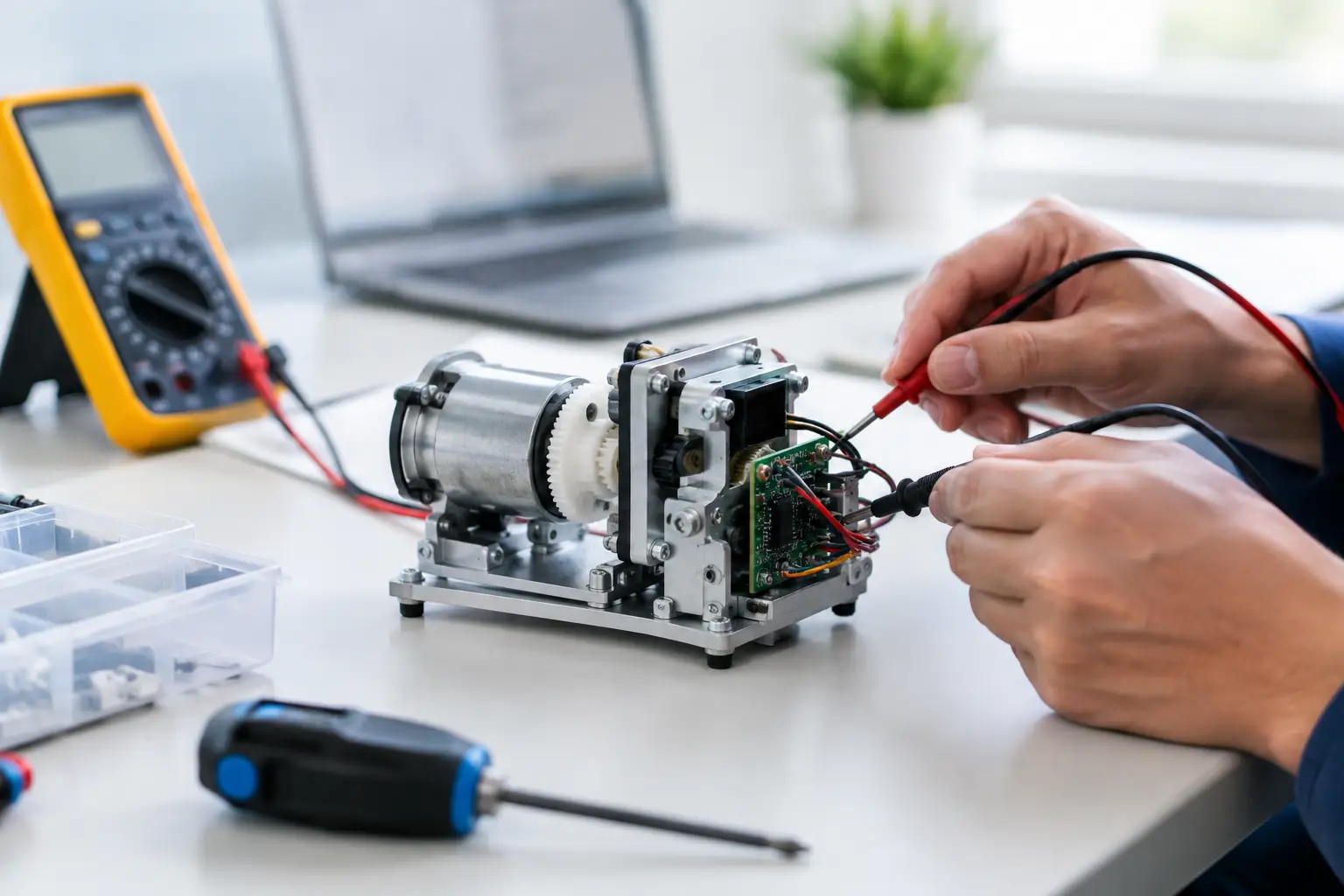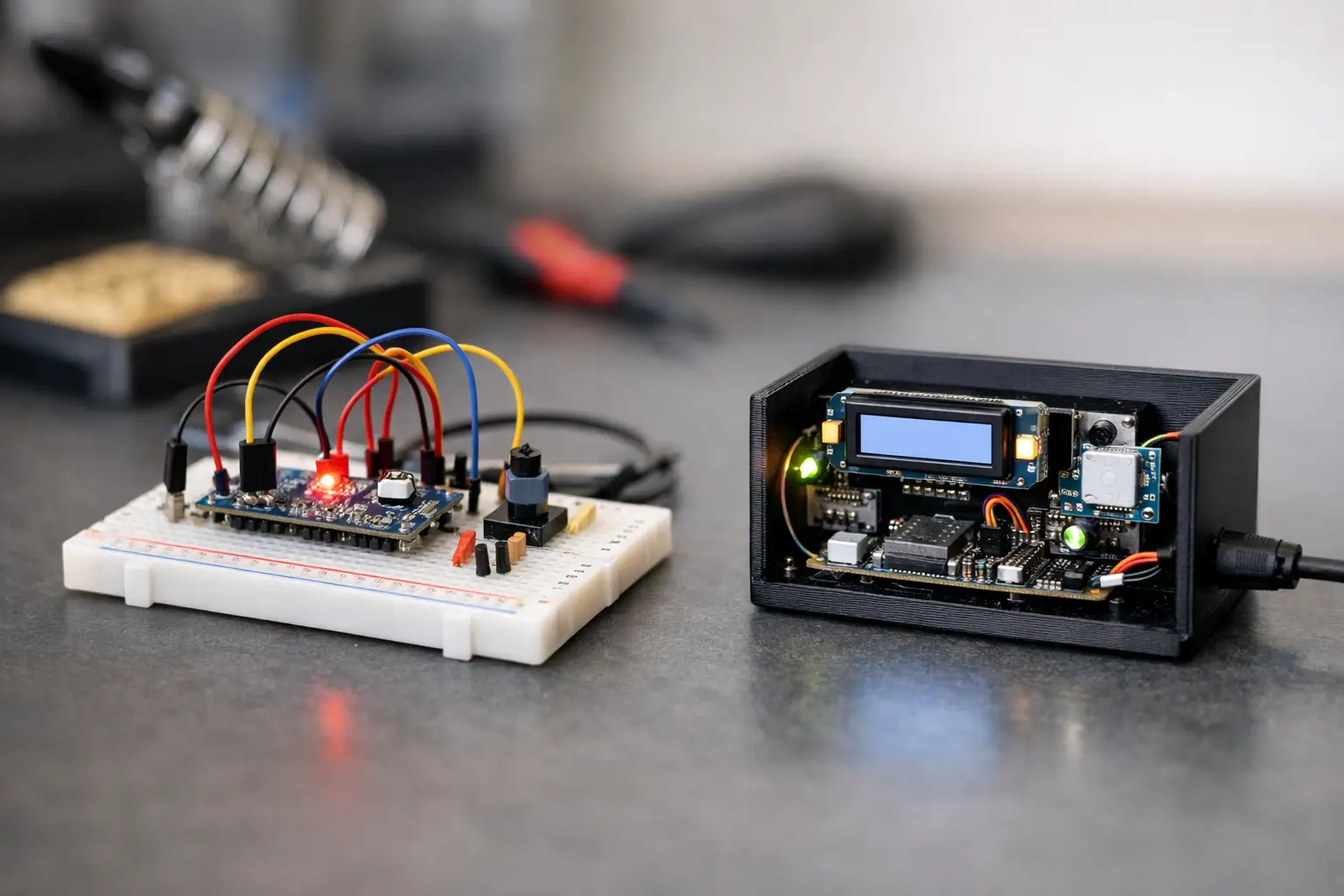
A circuit that blinks an LED on a workbench can be a meaningful breakthrough. It can also create a false sense that a product is nearly finished. The difference between a breadboard versus functional prototype is where many promising inventions either gain direction or lose time, money, and patent momentum.
For an inventor or startup founder, both models have value. They simply answer very different questions. A breadboard helps prove that an electrical idea can work. A functional prototype demonstrates that the product can work as a product, within the size, power, user, mechanical, and manufacturing constraints it will eventually face.
Knowing which stage you are in helps you invest in the right next step instead of paying to refine the wrong thing.
What a Breadboard Is Designed to Prove
A breadboard is a reusable platform for connecting electronic components without soldering. Engineers use it to quickly test a circuit, change resistor values, try sensors, evaluate logic, and identify whether a basic electrical approach is viable.
Picture an inventor developing a smart hydration bottle. On a breadboard, they may connect a microcontroller, water-level sensor, battery module, and indicator light. If the light changes when the bottle is filled, the core sensing concept has evidence behind it. That is useful. It may be the first proof that the invention deserves further development.
But a breadboard is intentionally temporary. Its jumper wires can disconnect, its components are often larger than production parts, and its electrical connections may behave differently from a designed circuit board. It does not reflect how a customer will hold, charge, clean, transport, or depend on the product.
A breadboard can answer questions such as: Does this sensor detect the intended input? Can these components communicate? Does the control logic work at a basic level? Is the selected technology worth pursuing?
Those are early engineering questions. They are not the same as market-readiness questions.
Breadboard Versus Functional Prototype: The Critical Difference
The central distinction is integration. A breadboard proves a subsystem or concept. A functional prototype integrates the critical systems into a form that resembles the intended product and performs its intended job reliably enough to evaluate.
A functional prototype may include a custom printed circuit board, a designed enclosure, properly selected motors or sensors, battery and charging provisions, software or firmware, controls, and mechanical parts made through 3D printing, machining, or other prototype processes. It does not need to look like a finished retail product, but it must be built around real-world use.
For example, a breadboard for a portable medical reminder might trigger an alarm at preset intervals. A functional prototype must also show that the alarm remains audible inside an enclosure, the battery lasts long enough, the buttons are usable, the housing protects the electronics, and the device can be assembled without fragile hand-wired connections.
That is where engineering decisions become interconnected. Changing the enclosure may reduce space for the battery. A smaller battery may require lower power consumption. Lower power consumption may affect screen brightness, wireless connectivity, or motor strength. A functional prototype reveals these trade-offs before they become expensive production problems.
Why the Transition Is Harder Than It Looks
A common mistake is treating a breadboard as a small version of a finished device. In reality, the move to a functional prototype is a redesign process.
Breadboard components are chosen for availability and testing speed. Functional components are selected for dimensions, durability, power demands, supply availability, cost, and compatibility with manufacturing. Jumper wires become designed electrical connections. A loose module becomes part of a circuit-board layout. A rough sketch becomes a housing with mounting points, tolerances, fasteners, access doors, and consideration for heat, moisture, or impact.
The transition also forces product decisions that may have been postponed. Who is the actual user? What happens if they press the wrong button? How often will the device be used? Will it be dropped? Does it need to be cleaned? Can a customer understand it without instructions? These are not cosmetic concerns. They influence engineering from the start.
This is why a functional prototype is often more valuable than a polished-looking model that does not function. A beautiful appearance model can help communicate a vision, but it cannot validate whether the product performs safely, consistently, and practically. Conversely, an unattractive but well-engineered functional prototype can reveal the risks that matter most.
When a Breadboard Is the Right Investment
A breadboard makes sense when the greatest uncertainty is technical feasibility. If your idea relies on a new sensing method, a control sequence, a wireless connection, or an electronic interaction that has not been proven, starting with a breadboard can prevent premature spending on custom parts and enclosures.
It is especially useful in the earliest proof-of-concept phase, when the goal is to test assumptions quickly. An inventor may learn that a chosen sensor cannot deliver accurate readings in the intended environment, or that a battery cannot support the desired operating time. Finding that out early is progress, not failure.
A breadboard may also be enough for some patent-related discussions. It can help document a working principle and support a more informed conversation about what may be novel in the system. However, prototype development and patent strategy should be aligned carefully. A prototype alone does not determine patentability, and public disclosure can affect rights. Inventors should seek qualified patent counsel for legal advice while keeping development records organized and confidential.
When You Need a Functional Prototype Instead
You need to move beyond a breadboard when the next decision depends on how the entire product behaves. This is often the case when you are preparing for investor demonstrations, customer testing, manufacturing estimates, licensing conversations, or a stronger patent-support package built around a clearly defined invention.
A functional prototype is also the practical next step when your product combines electronics with moving mechanisms, consumer handling, fluid exposure, wireless communication, or safety-sensitive features. Those conditions cannot be accurately evaluated through loose components on a bench.
The purpose is not to build the final production unit too soon. It is to build the right prototype for the decision ahead. An early functional prototype may use 3D-printed housings and low-volume fabrication methods because speed of learning matters more than per-unit cost. Later versions can focus on design for manufacturing, component sourcing, assembly efficiency, and appearance.
That sequence protects capital. Instead of committing to tooling or inventory based on assumptions, you test the product’s most important risks in stages.
A Practical Development Path
Most electromechanical products benefit from a clear progression. It begins with concept definition: what problem the product solves, who will use it, and what functions are essential. Next comes technical feasibility, which may include breadboard testing, calculations, component research, and basic software experiments.
Once the core approach is validated, engineering can translate it into an integrated functional prototype. This stage usually involves computer modeling, industrial design input, electrical design, mechanical design, prototype fabrication, and repeated testing. The result should answer whether the product can perform its intended function in a realistic form factor.
After that, the team can refine the design for manufacturing. That work addresses materials, tolerances, assembly methods, supplier constraints, testing procedures, regulatory needs, packaging considerations, and production cost. Skipping directly from a breadboard to manufacturing is possible only in unusually simple products, and it usually transfers unresolved risk to the most expensive point in the process.
Questions to Ask Before Funding the Next Build
Before choosing your next prototype, focus on the decision it must support. If you are still unsure whether the technology works, test the technology. If you know it works but do not know whether it fits into a usable product, fund functional integration. If the product works but is difficult or costly to build repeatedly, shift attention to manufacturing engineering.
It also helps to identify the single greatest risk. For one invention, it may be battery life. For another, it may be a moving mechanism, waterproofing, user safety, wireless reliability, or the ability to manufacture a part at an acceptable cost. The best prototype is not necessarily the most advanced one. It is the one that reduces the most important uncertainty.
Industry of Concepts helps inventors turn those uncertainties into an actionable development plan, from early proof-of-concept work through functional prototypes and manufacturing preparation. The goal is not to make an idea merely look real. It is to make informed engineering choices that move it closer to a product people can use, protect, and buy.
Your breadboard may be the moment an idea first proves it has potential. Treat the functional prototype as the moment that potential is tested against reality, where valuable inventions begin earning the confidence required to move forward.