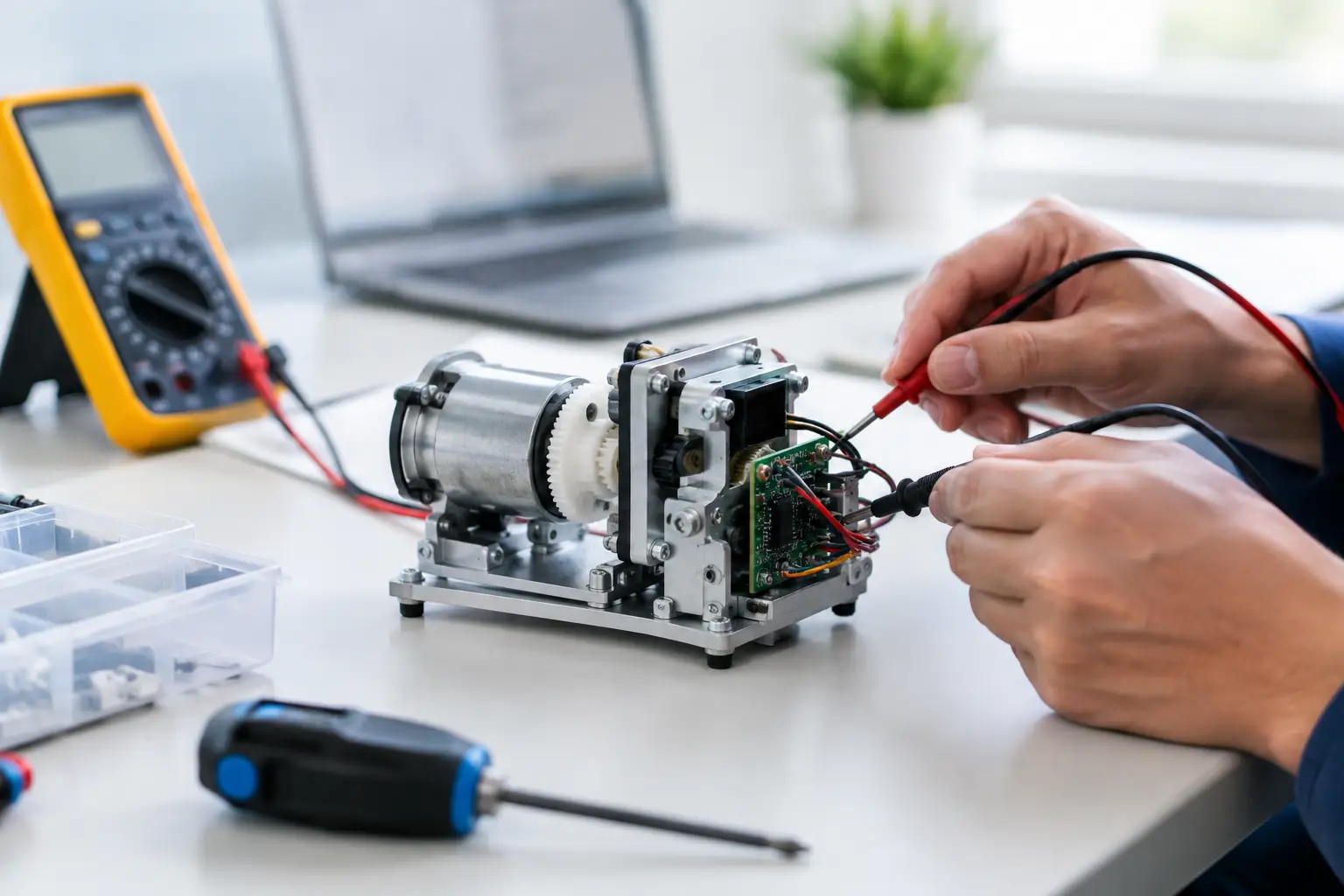
A prototype that turns on is not necessarily a prototype that is ready. A motor may spin on the workbench but stall under load. A latch may work ten times, then crack on the hundredth cycle. A sensor may perform perfectly in a quiet office and fail in the environment where customers will actually use it. That is why inventors and product teams must test electromechanical prototypes before making expensive tooling, production, or patent-related decisions.
Electromechanical products combine moving parts, electronics, software or controls, power, and user interaction. Each element can affect the others. Testing is how you replace assumptions with evidence and turn an interesting idea into a product that can be manufactured, protected, and sold with greater confidence.
Start With the Questions That Matter
Testing should begin before anyone reaches for a multimeter or starts a life-cycle test. First, define what the prototype must prove. Early proof-of-concept testing is different from production validation, and trying to test everything at once can waste time and budget.
For an early-stage invention, the central question may be simple: does the mechanism perform the intended task? A powered dispenser needs to dispense a repeatable amount. A locking device needs to lock and release on command. A portable tool needs to deliver the required force without becoming too heavy, hot, or difficult to hold.
As development advances, the questions become more demanding. Can the product operate repeatedly? Does it meet the expected battery life? Can users understand it without instruction? Are the parts practical to manufacture? Is there a safety concern if a wire loosens, a switch sticks, or a user applies more force than expected?
Write these requirements in measurable terms. “The device should be fast” is not a test requirement. “The actuator must complete a cycle in less than two seconds while carrying a 10-pound load” is. Specific requirements give your engineering team a clear pass-or-fail standard.
Build a Test Plan Around Product Risk
Not every feature carries the same risk. Focus first on the unknowns that could make the product impractical, unsafe, or too costly to produce. In many electromechanical inventions, those risks include torque and load capacity, heat buildup, battery performance, sensor reliability, noise, sealing, moving-part wear, and user misuse.
A useful test plan identifies the purpose of each test, the setup, the measurement method, the expected result, and what happens if the result falls short. This does not need to be a complicated corporate document. For a startup or independent inventor, a clear spreadsheet and disciplined documentation may be enough at the prototype stage.
The key is traceability. When a design changes, you should be able to see what was tested, what failed, what was corrected, and whether the correction solved the original problem. That record also supports smarter design decisions and can be valuable when discussing the invention with patent counsel, investors, manufacturers, or potential partners.
Test Electromechanical Prototypes in Layers
A practical testing process moves from basic function to real-world stress. If a fundamental component fails, there is little value in running an elaborate usability study or extended cycle test first.
Verify Individual Functions First
Begin by testing the product one subsystem at a time. Check the power source, charging circuit if applicable, motor or actuator, switches, sensors, controller, wiring, and mechanical assemblies. Confirm that inputs create the intended outputs and that the operating sequence is repeatable.
Measure rather than guess. Record voltage under load, current draw, actuator travel, cycle time, operating temperature, noise level, and force where relevant. A prototype can appear functional while consuming far more power than planned or producing insufficient force under real conditions.
This is also the right time to look for electrical and mechanical interactions. For example, a motor starting up may cause a voltage drop that resets the controller. A geartrain may introduce enough friction that a selected motor overheats. A wire route that looks acceptable in a CAD model may pinch when a hinged cover closes.
Test Under Realistic Loads and Conditions
Bench testing is necessary, but a product rarely lives on a bench. Put the prototype through conditions that reflect its intended use. If it is handheld, test it in the hands of people with different grip strengths. If it will be used in a garage, kitchen, warehouse, or outdoors, account for vibration, dust, moisture, temperature changes, and the way users actually handle it.
Realistic loading matters especially for products with motors, pumps, solenoids, springs, gears, latches, or linear actuators. Test the normal operating load, the highest expected load, and reasonable misuse. The goal is not to destroy every prototype for the sake of it. The goal is to learn where the design margin is too narrow.
A product that works only when every part is perfectly aligned may need a design change before production. Manufacturing variation is real. Parts will not all fit together with prototype-level perfection, particularly when 3D-printed components transition to molded, machined, stamped, or assembled production parts.
Run Cycle and Wear Tests
Many electromechanical failures do not appear in the first few uses. They emerge after repeated movement, vibration, friction, heat, or contact wear. Cycle testing helps reveal weak points in hinges, gears, springs, switches, connectors, fasteners, and housings.
The appropriate number of cycles depends on the product category and expected customer use. A novelty item and a daily-use appliance should not be tested to the same standard. Estimate how often a customer may use the product over its expected life, then use that estimate to set a practical target.
During testing, inspect the prototype at regular intervals. Listen for changes in sound. Check for loose fasteners, worn surfaces, cracked plastic, rising current draw, heat accumulation, and declining performance. A failure is useful when it points to a clear cause. “It stopped working” is less useful than “the gear tooth wore because the shaft alignment allowed side loading.”
Do Not Skip Safety and User Testing
Safety should be considered from the earliest functional prototype, even when the product is not yet ready for formal certification. Look for exposed electrical contacts, sharp edges, pinch points, overheating, unstable battery connections, unexpected motion, and failure modes that could harm a user or damage property.
If the product uses mains power, lithium batteries, heating elements, pressurized components, cutting surfaces, or high-force mechanisms, professional engineering oversight becomes even more critical. The correct test approach may depend on the product category, intended market, and applicable compliance requirements. A prototype test is not a substitute for required certification, but it can prevent costly surprises before formal compliance work begins.
User testing addresses another type of failure: the product may work technically but confuse the person using it. Give the prototype to representative users and watch what they do. Avoid explaining every step. If people press the wrong button, hold it incorrectly, force a component, or misunderstand an indicator, the design is giving them the wrong signal.
Ask focused questions after use. What did they expect to happen? What felt difficult? What seemed unreliable? Their feedback may lead to changes in the physical form, labeling, button placement, feedback signals, or operating sequence. Those changes are often less expensive before tooling begins.
Use Failures to Improve the Design, Not Just Fix a Symptom
When a test exposes a problem, resist the urge to apply the quickest patch and move on. Find the root cause. A broken mount may be caused by weak material, but it may also be caused by excessive load, poor geometry, an assembly tolerance issue, or a user action the product should have anticipated.
Design iterations should be deliberate. Change one or a small number of variables, document the revision, and test again against the same criteria. If several changes happen at once, it becomes difficult to know which one improved performance or introduced a new issue.
This is where an experienced development partner can save substantial time. At Industry of Concepts, prototype testing is treated as part of the product-development process, not a final checkpoint. Engineering, industrial design, and manufacturing considerations must work together if a concept is going to become a credible market-ready product.
Know When a Prototype Is Ready for the Next Stage
No prototype is perfect, and waiting for perfection can delay a promising product. The right question is whether the prototype has produced enough evidence for the next decision.
A proof-of-concept may be ready for patent discussions or early investor conversations once it demonstrates the inventive function. An engineering prototype may be ready for manufacturer feedback when critical mechanisms, electronics, form, and assembly approach the intended design. A pre-production prototype should demonstrate that the product can be made consistently with acceptable performance, cost, and quality.
Testing will always reveal another opportunity to improve. What matters is making each next investment based on facts, not hope. Bring your product into the real conditions it must survive, measure what happens, document what you learn, and let the results guide the next version. That is how an idea earns the right to become a product.