A product can look impressive in a sketch and still fail the moment someone tries to use it. It can also perform flawlessly on a workbench while feeling awkward, confusing, or too expensive to sell. That is the real issue behind industrial design vs engineering: both disciplines are essential, but they solve different parts of the product-development challenge.
For inventors and founders, treating them as separate, sequential tasks can create costly rework. The strongest products are designed and engineered together from the earliest stages, with clear attention to the user, the technology, the budget, intellectual property, and the realities of manufacturing.
Industrial Design vs Engineering: The Core Difference
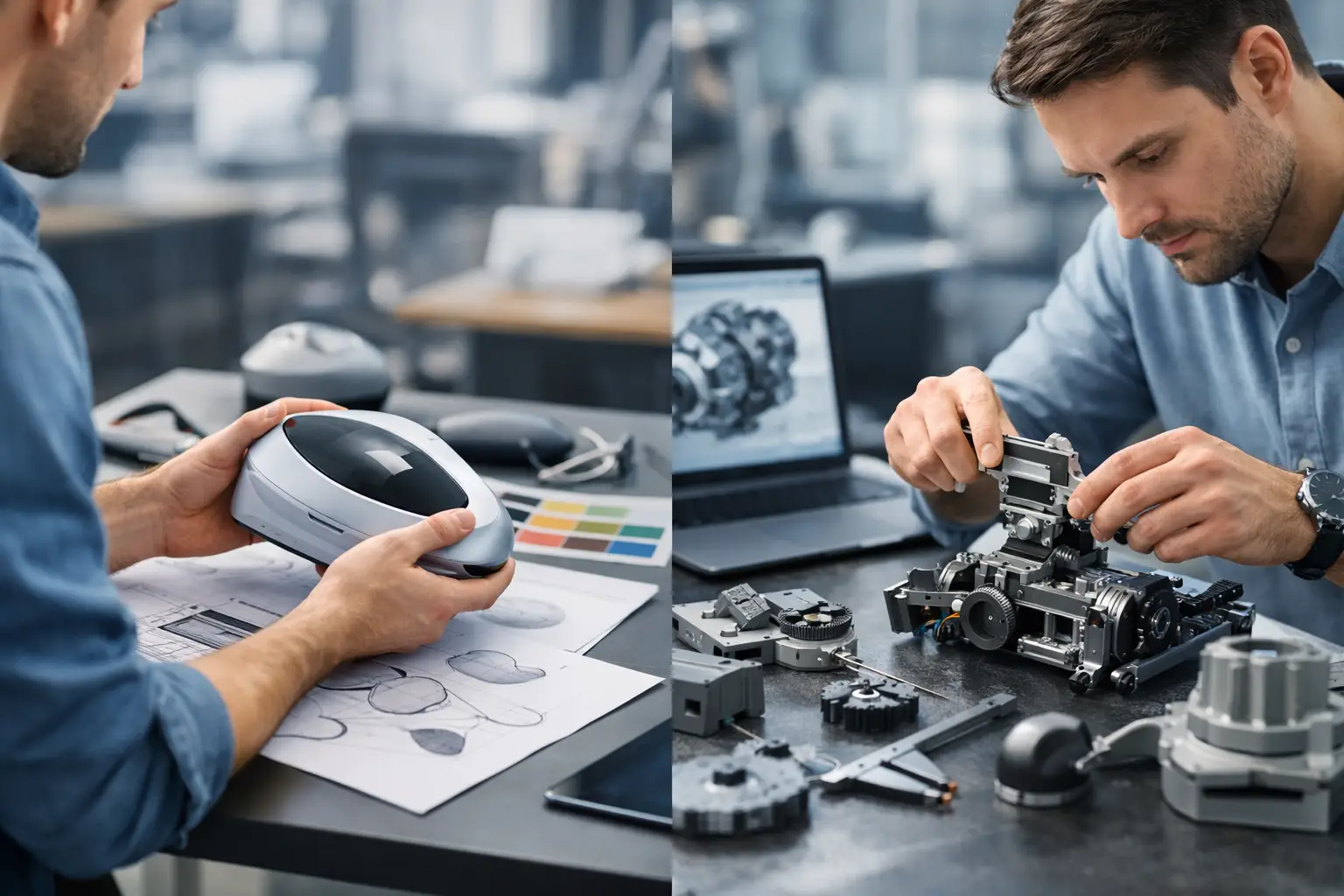
Industrial design focuses on how a product looks, feels, communicates, and fits into a person’s life. An industrial designer considers the user experience: how someone holds the product, understands its controls, opens its packaging, cleans it, stores it, and reacts to its appearance. They turn an early idea into a product people can recognize, understand, and want to own.
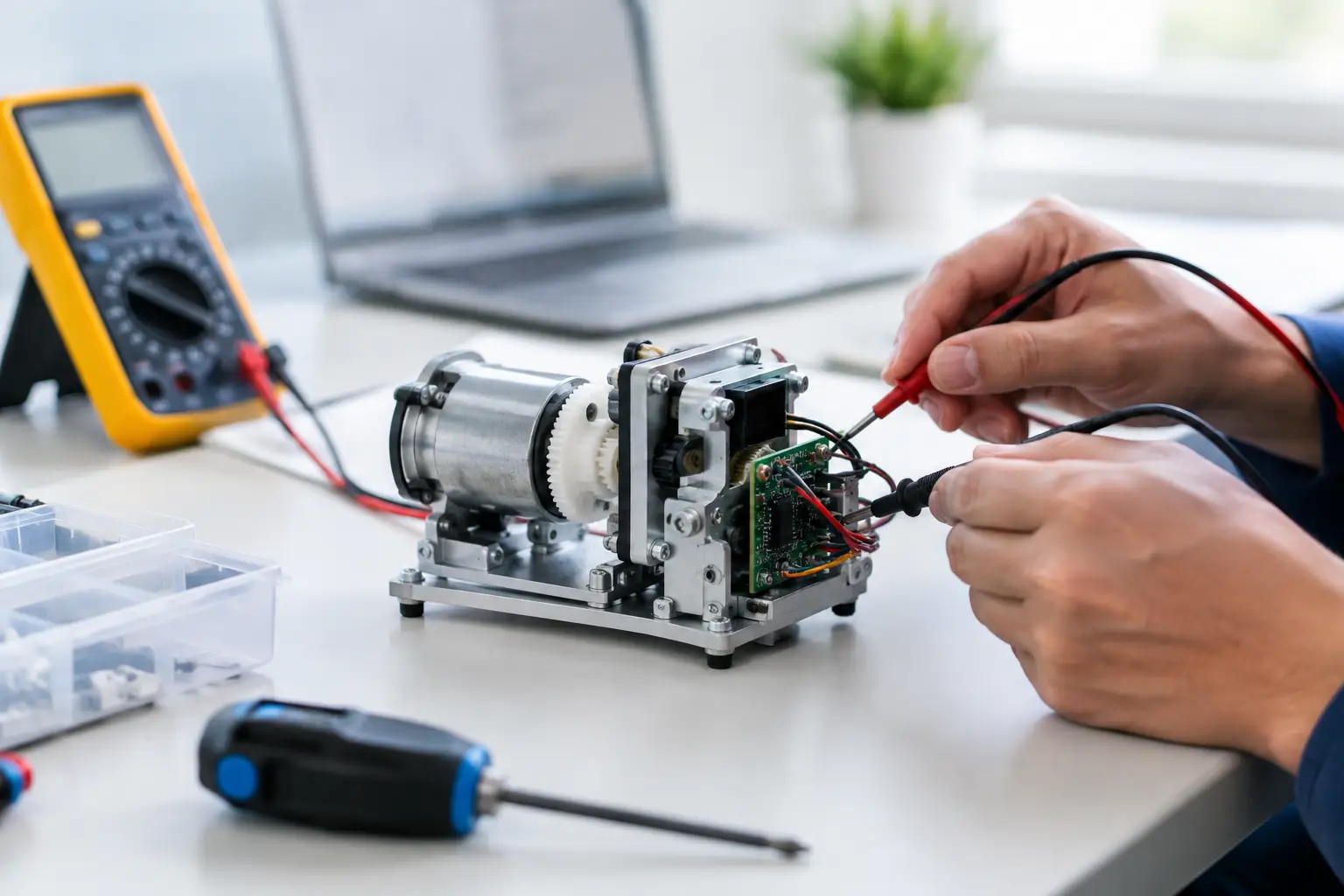
Engineering focuses on whether the product can reliably do its job. Engineers determine the mechanisms, materials, electronics, power requirements, structural strength, tolerances, heat management, safety factors, and production methods that make the concept functional. They convert a product vision into specifications, models, calculations, and testable systems.
The distinction is easy to understand with a handheld consumer device. Industrial design shapes the grip, button placement, enclosure proportions, visual identity, and perceived quality. Engineering determines how the internal components fit, whether the housing survives drops, how the battery performs, whether the buttons last through repeated use, and how the device can be assembled at scale.
Neither role is “more important.” A product that is beautiful but unreliable will damage customer trust. A product that works but is difficult to use or visually unconvincing may never gain traction. The value lies in the connection between the two.
What Industrial Design Brings to a New Product
Industrial design starts with people. That does not mean it is only about styling. Good design research asks who will use the product, what frustrates them now, where the product will be used, and what will make the experience easier or safer.
For a kitchen tool, that may mean designing a handle that works with wet hands and is comfortable for both left- and right-handed users. For a medical or wellness product, it may mean making controls readable for someone with limited dexterity. For a professional tool, it may mean building in visual cues that reduce training time and user error.
Industrial designers also establish a product’s visual language. Shape, color, texture, finish, graphics, and material choices influence perceived quality long before a customer can evaluate technical performance. A low-cost appearance can weaken a premium product position. A sleek form that cannot be molded or assembled economically, however, is not a complete solution.
This is why industrial design must account for manufacturing early. The goal is not simply an attractive rendering. The goal is a product form that supports usability, brand value, production, and cost targets.
What Engineering Brings to the Table
Engineering gives a product its proof. It answers the practical questions that determine whether an idea can become a working prototype and, eventually, a repeatable manufactured product.
Mechanical engineering may address moving parts, enclosures, gears, springs, seals, structural loads, and material selection. Electrical engineering may define sensors, circuit boards, batteries, motors, charging systems, controls, and connectivity. Depending on the product, software, firmware, thermal analysis, or manufacturing engineering may also be required.
An engineer’s work often reveals constraints that are invisible in an early concept. A thin enclosure may not leave enough room for a battery. A selected material may crack under a required load. A motor may generate heat that changes the shape or ventilation needs of the housing. A part that looks simple may require an expensive manufacturing process.
These discoveries are not failures. They are exactly why professional engineering is needed before committing to tooling, inventory, or a public launch. Early testing exposes what needs to change while the cost of change is still manageable.
Why Products Need Both From the Beginning
Many first-time inventors begin with one of two assumptions: “I need a design because I know what it should do,” or “I need an engineer because I already know what it should look like.” Both assumptions can lead to delays.
If design happens without engineering input, the concept may depend on impossible wall thicknesses, hidden components with no space to fit, or features that are too expensive to manufacture. If engineering moves ahead without industrial design input, the prototype may function but lack the usability and market appeal needed to win customers.
A better process creates an ongoing conversation. The designer proposes a user-centered form. The engineer evaluates the internal package and technical feasibility. The designer adjusts the experience around real constraints. The engineer refines the architecture, materials, and performance. Each pass improves the product.
This collaboration is especially valuable when protecting intellectual property. A prototype developed for patent-oriented support should demonstrate the inventive principle clearly, not merely present an attractive shell. At the same time, a functional proof of concept should be designed in a way that helps others understand its intended use and commercial potential.
Where the Lines Overlap
The boundary between industrial design and engineering is not always sharp. Both professionals may use 3D CAD models, build prototypes, evaluate materials, and participate in user testing. Both need to understand manufacturing limitations. Both are responsible for solving problems.
The difference is in the questions they lead with. Industrial design asks, “What should the user experience be?” Engineering asks, “What must happen for the product to work consistently?” The best development teams respect both questions at the same time.
Consider a portable safety device. The industrial designer may advocate for a compact shape that fits naturally in a pocket, a control that can be located by touch, and a visual design that signals reliability. The engineer determines whether the safety mechanism prevents accidental activation, whether internal components tolerate impact and temperature changes, and whether the selected battery can deliver required power.
One decision often affects another. Making the product smaller may reduce battery capacity. Adding a protective guard may improve safety but complicate operation. A premium material may improve perceived value but increase cost or interfere with wireless performance. Product development is a process of making informed trade-offs, not chasing a perfect answer in isolation.
Choosing the Right Starting Point for Your Idea
The right first step depends on how developed your idea is. If you have identified a market need but have not settled on the product’s form or user experience, concept development and industrial design can clarify the opportunity. Early sketches, user scenarios, and visual models make vague ideas easier to evaluate.
If you already have a defined mechanism, technical problem, or rough prototype, engineering may need to lead. This is common with inventions involving motion, electronics, fluid flow, specialized materials, or safety-critical functions. The objective is to establish feasibility before investing heavily in appearance.
Most products reach a point where both are necessary. A consumer product usually needs industrial design sooner than founders expect because usability and visual differentiation affect market acceptance. A technically complex product usually needs engineering sooner than founders expect because performance and manufacturability can reshape the original concept.
Rather than asking which discipline comes first in every case, ask what uncertainty creates the biggest risk right now. Is it whether people will understand and want the product? Is it whether the mechanism can work? Is it whether the product can be made within a viable cost range? The answer should guide the next development activity.
From Concept to a Prototype You Can Use
A prototype is where design and engineering stop being separate conversations and become physical evidence. Early appearance models can help evaluate size, ergonomics, and customer reaction. Functional prototypes can test mechanisms, electronics, and materials. More advanced prototypes can bring these elements together for demonstrations, investor discussions, patent support, or manufacturer feedback.
Do not expect one prototype to answer every question. A 3D-printed housing may be ideal for testing grip and proportions but not representative of final material strength. A breadboard may prove an electronic function but not fit the final enclosure. This is normal. Each prototype should have a defined purpose, a test plan, and a decision attached to its results.
Industry of Concepts helps clients coordinate industrial design, computer modeling, prototyping, and engineering as connected stages of a practical development path. That approach reduces the risk of receiving a design that cannot work or an engineering prototype that is not ready to become a product.
Your idea does not need to arrive as a polished specification. It needs a clear problem worth solving and the willingness to test it honestly. Start with the uncertainty that could cost you the most, build the right evidence, and let design and engineering move the product forward together.