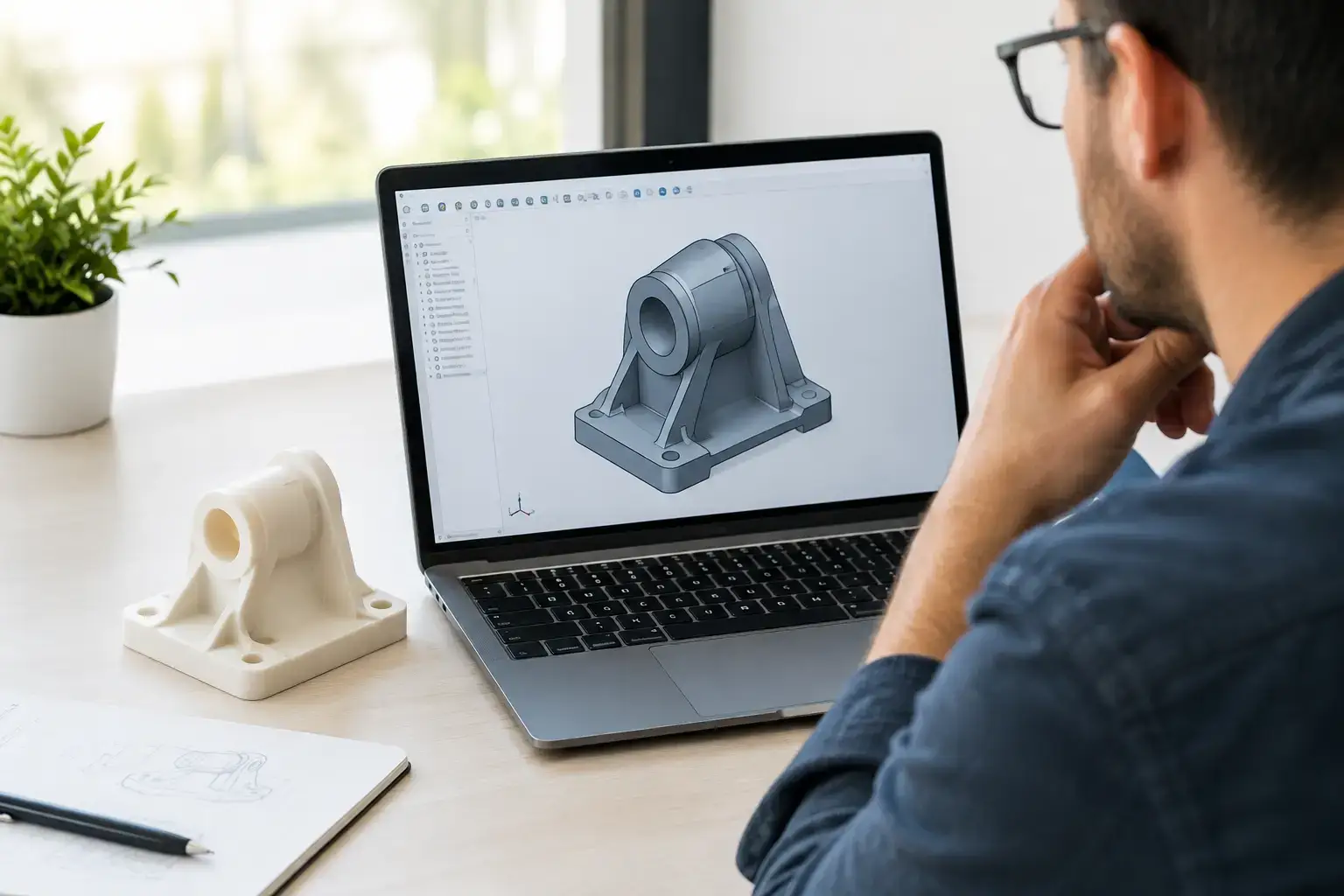
A sketch on a notepad can feel like a breakthrough. But a strong idea is not automatically a viable product. The difference is invention idea validation: the disciplined work of determining whether a concept solves a real problem, can be built reliably, and has a market willing to pay for it.
Many inventors lose time and money by jumping directly from an idea to a patent filing, polished prototype, or manufacturing quote. Those steps may be necessary, but they are more effective when they follow evidence. Validation gives you that evidence. It turns assumptions into questions that can be tested before major commitments are made.
What Invention Idea Validation Actually Tests
Validation is not one conversation with a friend who says, “That’s a great idea.” It is a series of practical checks that reveal where the concept is strong, where it needs refinement, and whether it deserves further investment.
At an early stage, the most useful questions are straightforward:
- What specific problem does the product solve, and how often does that problem occur?
- Who experiences the problem strongly enough to change their current behavior or spend money?
- What do they use now, and why is that option inadequate?
- Can the proposed product be engineered, manufactured, and sold at a realistic price?
A product can be technically impressive and still fail because the customer does not feel enough urgency. The reverse can also happen: a product may answer a real need but require an expensive mechanism, uncommon material, or complicated assembly process that makes the business model unworkable. Good validation addresses both sides.
Start With the Problem, Not the Feature List
Inventors naturally focus on what makes their concept new. Customers focus on whether it makes their life easier, safer, faster, less expensive, or more enjoyable. That gap matters.
Describe the product without using technical language at first. Instead of saying, “It is a portable, electronically actuated storage unit,” say what the user gains: “It keeps tools organized and accessible in tight workspaces.” If that benefit does not immediately resonate with the intended buyer, the concept may need a sharper market position.
Speak with prospective users who actually live with the problem. For a consumer product, that could mean people in a specific household, hobby, or lifestyle group. For a business product, it should include the people who use it, the people who approve purchases, and sometimes the people responsible for maintenance or safety.
Ask about their current process before introducing your solution. What frustrates them? What have they tried? What does the problem cost in time, waste, inconvenience, or risk? Their answers are more valuable than compliments about your idea because they show whether the problem is substantial enough to support a product.
Research the Existing Market Honestly
Competition is not automatically bad news. In many cases, it proves customers already understand the category and spend money in it. The real question is whether your product provides a meaningful advantage over what exists.
Review competing products across retail listings, trade catalogs, product packaging, customer reviews, and industry publications. Look beyond the obvious competitor. Your real competition may be a workaround, a manual task, a service provider, or the customer doing nothing at all.
Pay close attention to negative reviews. They often reveal openings in the market: a product breaks too quickly, takes too long to set up, is difficult to clean, lacks a needed feature, or costs more than the value it provides. These issues can guide the design requirements for your invention.
Be careful not to confuse “different” with “better.” A product feature is valuable only if it solves a problem customers recognize. If your distinction requires a lengthy explanation, a buyer may not understand it quickly enough at the point of sale.
Define Your Advantage in One Clear Statement
A useful test is to complete this sentence: “For [target user] who struggles with [specific problem], this product provides [primary benefit] unlike [current alternative] because [meaningful difference].”
If you cannot fill in that statement clearly, more research is needed before spending heavily on engineering or intellectual property work. A focused product story also helps guide every later decision, from prototype features to packaging and pricing.
Test Feasibility Before Promising Too Much
The next stage of invention idea validation is technical. A concept must do more than look plausible. It must function under real conditions, use available components or materials, and meet the expectations of its intended market.
Some risks are visible early. A moving mechanism may create friction, fatigue, noise, or safety concerns. A battery-powered product may have limited run time or require a charging approach that users dislike. A compact design may be difficult to assemble. A product intended for children, food contact, medical settings, or demanding work environments may face added compliance requirements.
This is where engineering input makes a measurable difference. An experienced product development team can identify the assumptions hidden in a sketch and determine which ones should be tested first. That may involve computer modeling, material selection, component research, early electronics development, or a proof-of-concept model.
A proof-of-concept is not meant to be beautiful. It is meant to answer a critical question: does the core function work? Building one early can prevent the costly mistake of investing in a presentation-ready prototype before the engineering has been proven.
Validate the Economics Alongside the Design
A product that works is not necessarily a product that can be sold profitably. Cost validation should begin long before tooling and production orders.
Estimate the likely cost of materials, purchased components, assembly labor, packaging, shipping, quality control, and expected returns. Then compare that total with the price your target customer is likely to accept. If the product will be sold through distributors or retailers, their margins must also fit the model.
The answer may be to simplify the design, remove a nonessential feature, choose a different manufacturing method, or target a premium market where the benefit justifies a higher price. It depends on the product category and sales channel. A direct-to-consumer product can support a different structure than a product that must pass through several layers of distribution.
Do not let a low early prototype cost create false confidence. A single hand-built sample is very different from a repeatable production process. Manufacturing engineering evaluates how parts will be made, assembled, tested, and inspected at volume.
Use Prototypes to Learn, Not Just to Impress
A prototype is one of the most powerful validation tools available, provided it is built for a defined purpose. The right prototype depends on the question you need answered.
A rough model may test size, grip, reach, and user interaction. A functional prototype may test a mechanism, electronics, load capacity, or durability. A refined appearance model may help assess customer reaction, investor interest, or buyer presentations. Trying to make one prototype perform every role often increases cost and delays learning.
Put the prototype in front of potential users and observe them. Do not immediately explain every feature. Watch where they hesitate, what they misunderstand, and whether they naturally use the product as intended. Their behavior can reveal flaws that direct questions miss.
Feedback should not be treated as a vote. One user may request a feature that would complicate the product for everyone else. Look for repeated patterns, especially when they connect to the central problem your invention is meant to solve.
Consider Patent Direction Early, but Strategically
Validation and patent planning should move together. Before sharing details broadly, understand what may be protectable and how public disclosure could affect your options. A patent search can reveal related inventions, while patent-oriented prototype development can help clarify how your concept functions and where its novel elements may reside.
However, patentability alone does not validate a business opportunity. A patent does not guarantee demand, manufacturability, or sales. Likewise, a crowded patent landscape does not always end a project, but it may require a different design approach, a narrower claim strategy, or a decision to pursue the market through brand, execution, and speed instead.
The goal is to make informed choices while there is still room to change the design. Waiting until after a product is fully developed can make those changes much more expensive.
Know When the Evidence Supports the Next Investment
Validation rarely produces perfect certainty. Product development is a managed risk, not a promise that every new product will succeed. The objective is to reduce the largest unknowns in the right order.
You are ready to move forward when you can clearly identify the customer problem, demonstrate a credible advantage over alternatives, show that the core function can work, and outline a path to a viable cost structure. If one of those areas is weak, that does not mean the idea is over. It means the next step should be targeted research or prototype work rather than a larger investment.
Industry of Concepts helps inventors turn uncertain concepts into practical development plans, functional prototypes, and stronger foundations for commercialization. The right time to test your idea is before the expensive decisions are locked in. Give your invention the chance to prove itself before you ask the market to do the same.